
Found‑Rᵧ
A browser workbench for carrying a Custom GPT from its first brief to a reviewed, exportable specification.
Browser workbench; maturity unverified. Operation unverified.
Status and source
Availability: Published project. Maturity: Browser workbench; maturity unverified. Evidence: Source description only. Delivery: unknown. Source record (reviewed 2026-09-07).
About the project
Tools for making tools.
A browser-only build workbench for production-grade Custom GPTs. Nine stations carry a build from raw intent to a governed, shippable artifact: brief, contract, instruction stack, knowledge routing, capabilities, actions, starters, test matrix, ship gate. Then audit it against a rubric, compare it across platforms, and export the whole specification as one document. No backend. No database. No login. Everything stays in your browser.
A good prototype is not a thing you can hand to anyone
The builder UI rewards vagueness
Every Custom GPT builder opens with a chat box and an encouraging tone. You describe what you want, it writes instructions for you, and you ship something that behaves fine in the demo and drifts the moment a real user arrives. Nothing in that flow ever asks what the GPT must refuse to do.
The hard parts have no surface
Scope boundaries, catastrophic failure modes, knowledge retrieval routing, capability rationale, red-team cases, version ownership. These are the decisions that separate a working GPT from a demo, and no builder interface has a field for any of them.
The reasoning evaporates
Six weeks later nobody remembers why Code Interpreter was enabled, which data sources were deliberately excluded, or what the acceptance criteria were. The GPT still runs. The thinking behind it is gone, which means it cannot be reviewed, inherited, or safely changed.
There is no exit
Work done inside one vendor's builder stays inside that vendor's builder. Moving the same capability to a Gemini Gem or a Copilot declarative agent means starting over from memory, because the specification only ever existed as configuration in someone else's product.
Ore, heat, anvil, quench
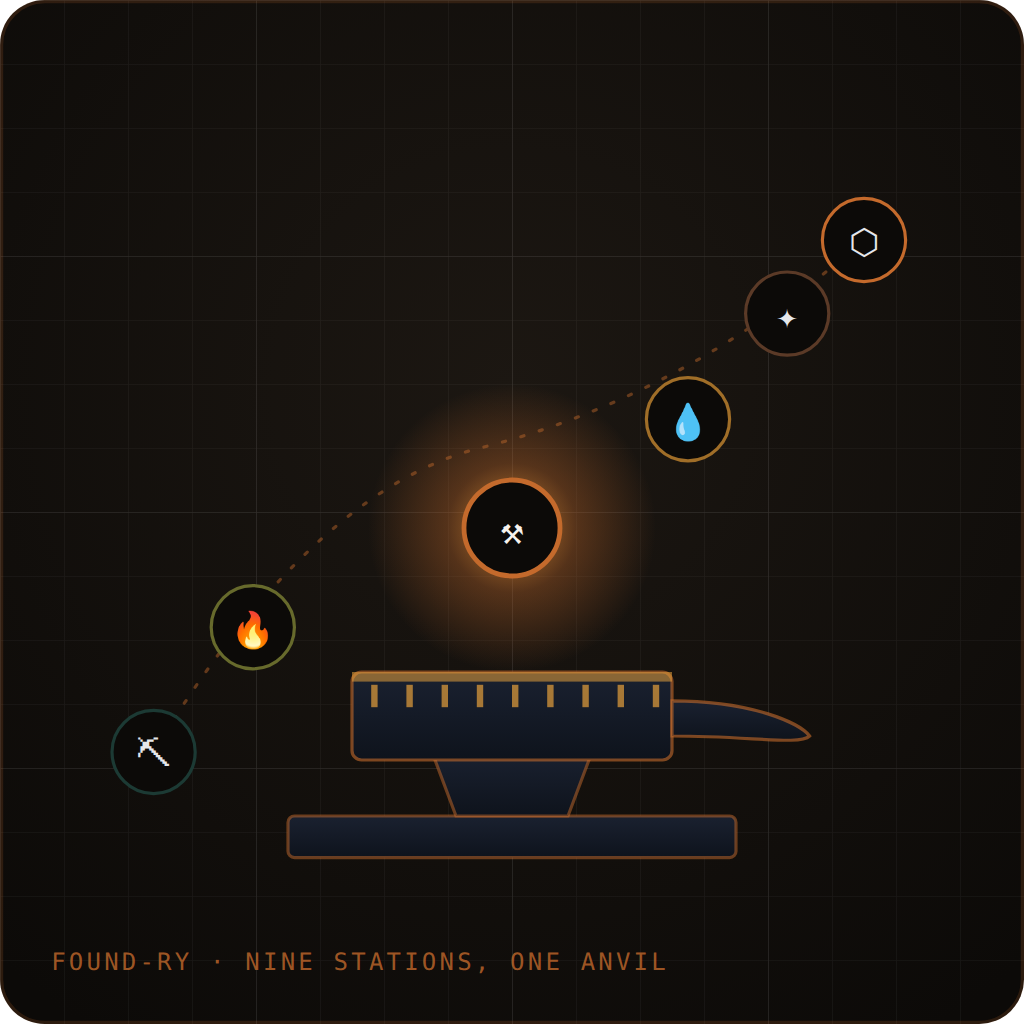
The naming is not decoration. A blacksmith's shop is a sequence of stations, and each one does something the previous station made possible. Raw material arrives, gets worked, gets tested, gets marked, goes on the shelf. The Found‑Rᵧ is the building. The stations are the method.
The ore is the prompt
Raw, valuable, and useless in its current state. A prompt that worked once is a lump of something promising. It is not yet a tool, and treating it like one is how teams end up with forty clever prompts nobody can reuse. The ore is mined and graded at the Prompt Forge.
The heat is the pressure of specificity
Material only moves when it is hot enough. Here the heat is being forced to answer questions the builder UI never asks: who is this for, what does done look like, what must it refuse, what happens when it fails. Uncomfortable questions are the working temperature.
The anvil is the nine stations
Shape gets beaten in one deliberate strike at a time. Brief, contract, instruction stack, knowledge, capabilities, actions, starters, tests, ship. Each station produces an artifact the next one depends on, which is why the order is not negotiable.
The quench is where you find out
Steel goes into water and either hardens or cracks. The test matrix and the audit rubric are the quench: a scored pass across six categories plus a red-team pack, with a gate that will tell you the build is not ready. A quench that never fails anything is not a quench.
The maker's mark is governance
A smith stamps the work because someone will need to know who made it and when. Visibility, version scheme, named owner, change log, scheduled review. Unsigned work is anonymous work, and anonymous work never gets maintained.
The shelf is where it becomes reusable
A finished tool that stays on the workbench is still a private object. Packaged as a portable contract and placed in Skillz Forge, it becomes something another agent, another project, or another person can pick up and use without asking you first.
Where this sits in the ecosystem
The same capability moves through four surfaces: design, packaging, discovery, and preservation. Each surface does one job and hands off. Found‑Rᵧ is the second.
No surface duplicates another. A prompt is hardened at Stage 01, given a specification and a governance record at Stage 02, made discoverable at Stage 03, and preserved with its full change history at Stage 04.
Raw prompt enters Prompt Forge, then Found-Ry's nine stations, followed by Test matrix and audit. If it fails the gate, it returns to Found-Ry for revision and another test. If it passes the gate, it moves to Ship and govern, then Skillz Forge for discovery and GitHub for its history and review record.
The loop from the quench back to the anvil is the part most build guides leave out.
Nine stations, in this order, for a reason
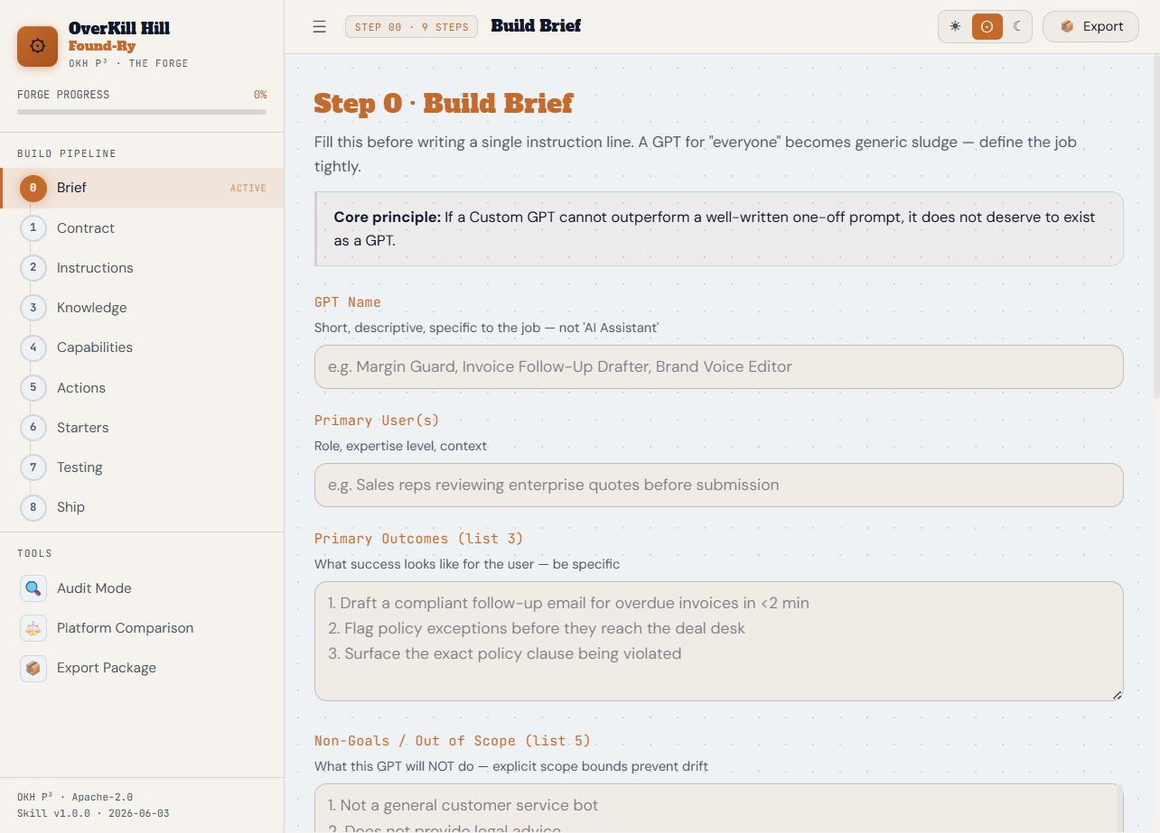
Each station writes an artifact the next station consumes. You can skip ahead, and the tool will let you, but the instruction stack is much harder to write when the conversation contract is still blank. The sequence is the opinion.
| Station | Name | What you settle here |
|---|---|---|
| 00 | Build Brief | The job, the users, primary outcomes, explicit non-goals, measurable acceptance criteria, allowed and disallowed data sources |
| 01 | Conversation Contract | Inputs in, outputs out, the top tasks it must nail, and the catastrophic failure modes that would make it worse than nothing |
| 02 | Instruction Stack | Eight ordered layers inside a hard character budget, so instruction weight lands where behavior actually changes |
| 03 | Knowledge Files | The file manifest and the retrieval routing notes that tell the model which document answers which kind of question |
| 04 | Capabilities | Every capability on or off with a written rationale, because a capability nobody can justify is a capability nobody can defend |
| 05 | Actions and Apps | OpenAPI schema authoring or connector selection, held mutually exclusive so the integration surface stays legible |
| 06 | Conversation Starters | Three or four prompts that launch real workflows, scored against a quality checklist that rejects slogans |
| 07 | Test Matrix | Ten to fifteen cases across six categories, red-team pack included, with pass and fail recorded rather than remembered |
| 08 | Ship and Govern | Visibility, version scheme, named owner, change log, scheduled review date, and a gate that checks the rest is done |
Three tools that run on the finished work
Score it before you defend it
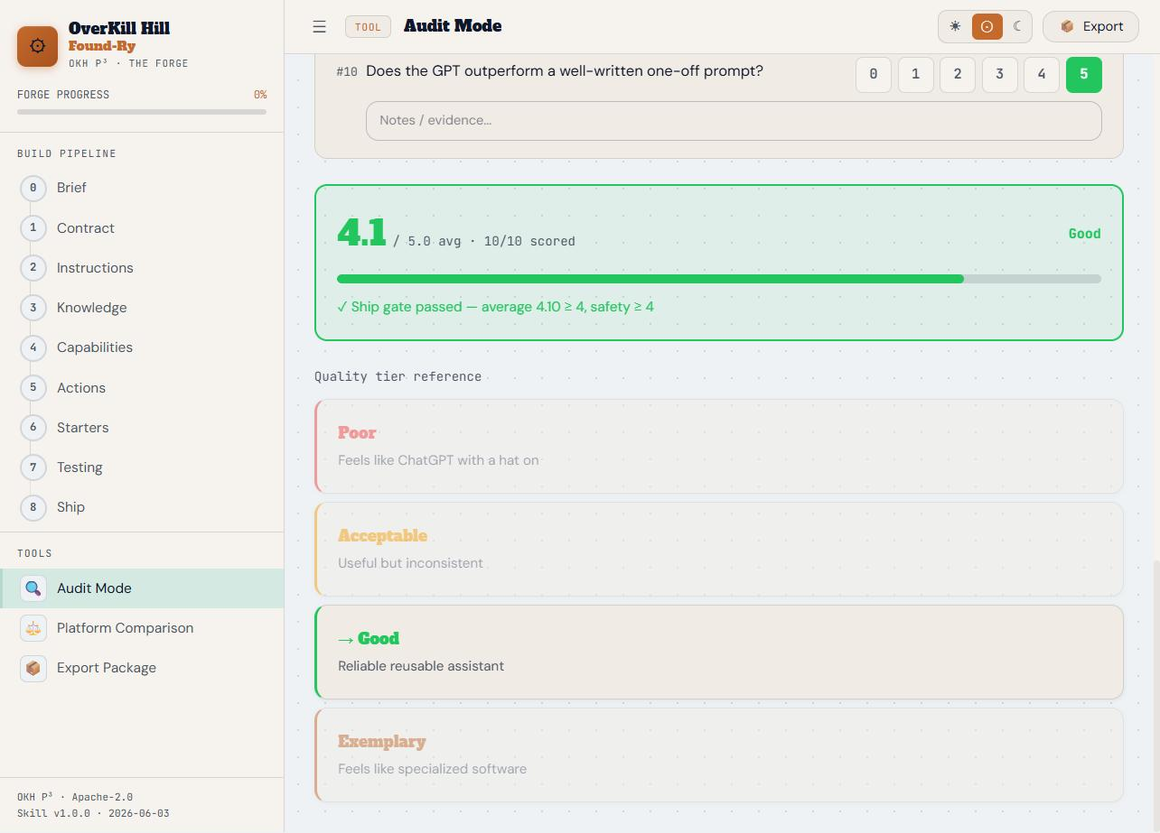
A ten-item rubric scored zero to five, with a ship gate that requires an average at or above four and a safety score no lower than four. Audit Mode is designed to fail builds. A rubric that passes everything is a decoration, not a control.
Decide where it should live
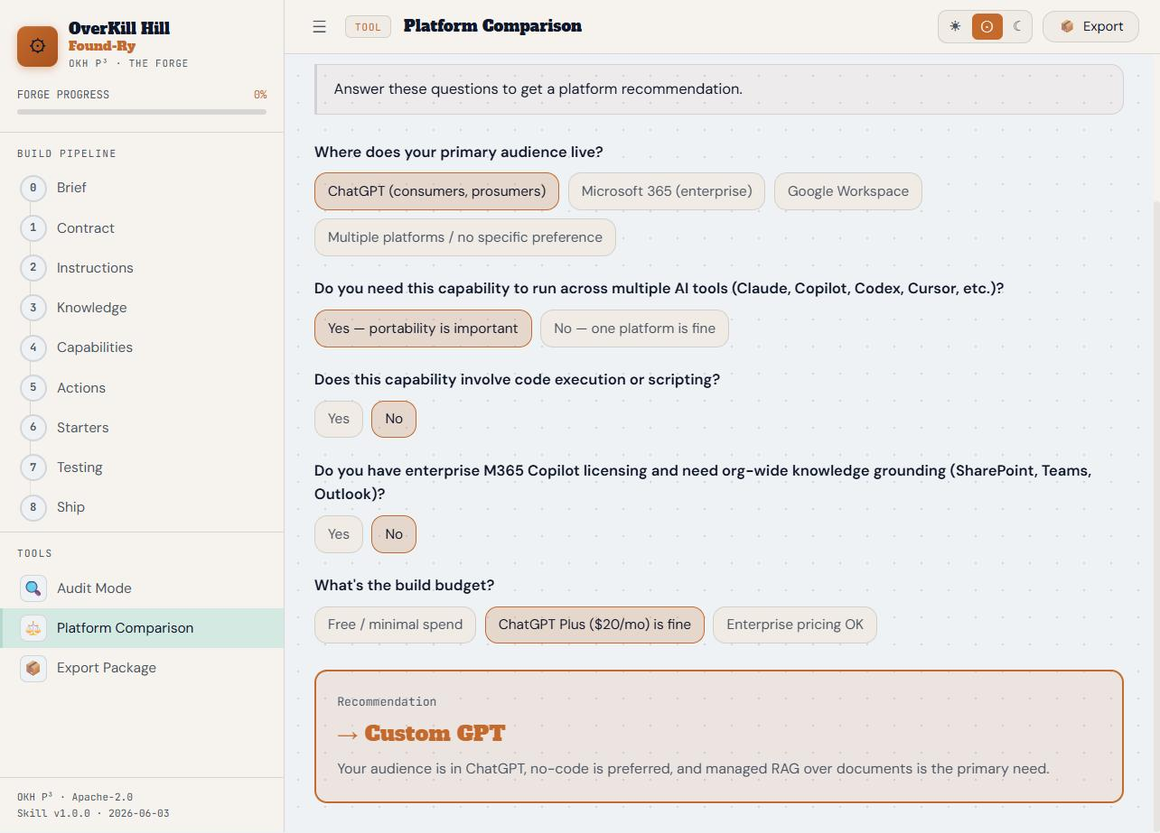
A decision tree and feature matrix across OpenAI Custom GPTs, Gemini Gems, and Microsoft Copilot declarative agents, plus a taxonomy and an evolution timeline. Because the right answer is sometimes a different platform, and sometimes it is a plain prompt.
Leave with the specification
Assembles every station into one Markdown specification you can copy, download, commit, or hand to a reviewer. There is also an instructions-only view for pasting straight into a builder. The export is the artifact. The tool is just how you got there.
A design workbench, not a hosting platform
- ◆A structured workbench for designing a Custom GPT properly
- ◆An audit surface with a rubric that can withhold a pass
- ◆A platform comparison for GPT, Gem, and Copilot agent
- ◆A Markdown specification generator you can commit anywhere
- ◆Browser-only, no login, local storage, free always
- ◆The operational face of the
okhp3-custom-gpt-buildermethod
- •Not a place to run or host a Custom GPT
- •Not connected to any vendor API or account
- •Not a prompt generator that writes the GPT for you
- •Not a guarantee that a scored build will behave in production
- •Not a replacement for testing against real users
- •Not a marketplace, a directory, or a social layer
The rules the workbench runs on.
If a prompt would do the job, do not build a GPT
The workbench opens with this as its stated core principle. A Custom GPT that cannot outperform a well-written one-off prompt does not deserve to exist, and the Build Brief is designed to surface that verdict early rather than after the build.
Non-goals are a first-class field
Scope drift is the default failure mode of anything built for everyone. Explicit out-of-scope bounds are captured at station zero and carried forward, because what a tool refuses is as much a design decision as what it does.
Every capability carries a rationale
Toggling a capability on is easy and reversible. Writing down why is neither, which is exactly the point. The rationale field is what makes a capability decision reviewable six months later by someone who was not in the room.
The gate has to be able to say no
Audit Mode enforces a minimum average and a separate safety floor. A build can score well overall and still be blocked on safety alone. A quality gate that cannot fail a build is a progress bar wearing a costume.
The specification leaves with you
Everything exports to plain Markdown. No account, no lock-in, no proprietary format, no dependency on this site continuing to exist. If the workbench disappeared tomorrow, the artifacts it produced would still be readable and still be yours.
Nothing leaves the browser
No backend, no database, no authentication, no telemetry on your build content. Every station persists to local storage only. The design brief for a GPT often contains the most sensitive thinking in a project, and it stays on your machine.
The first five hundred pieces
Custom GPTs are yesterday's news, and that is beside the point. They were the first set with enough pieces to be genuinely hard, and building them badly, then less badly, is where the systems thinking behind everything else on this site actually came from.
The original Found‑Rᵧ was an idea rather than an application: tools for making tools. Prompts that became GPTs that wrote better prompts, which produced better GPTs. That loop worked. It produced the prototypes and the working method that made Glee-fully Chai Chasers possible.
What it could not do was package anything. The prompts, the scripts, and the proto-GPTs stayed trapped as clever artifacts in a private workspace, reusable only by the person who wrote them and only while he still remembered how. The gap was never the thinking. It was the absence of a way to turn the thinking into something with an interface, a repository, and a URL.
That gap is now closed. The page you are reading sits in front of the workbench that the original idea was always describing.
The workbench operationalizes the okhp3-custom-gpt-builder Agent Skill: the canonical build methodology, phases, audit criteria, and platform comparison data. The skill runs in agent environments. The workbench runs in a browser. They stay in sync deliberately.
The workbench lives inside a FoundRy relay repository alongside the ReFolDec process framework, the brand style registry, and the Agent Skills library. Source, build workflow, and deployment are all public.
OKHP3/OverKill-Hill-FoundRy ↗Where the build is going
-
✓
Nine-Station Build Pipeline Shipped
All nine stations live with per-station local storage persistence, completeness meters, a sidebar pipeline with progress tracking, and light, dark, and system theme support resolved before first paint.
-
✓
Audit Mode, Platform Comparison, Export Package Shipped
Ten-item scoring rubric with an enforced ship gate, a three-platform decision tree and feature matrix, and full Markdown specification export with an instructions-only view.
-
✓
Public Deployment Shipped
Continuous deployment to GitHub Pages from the repository's main branch via GitHub Actions. Client-only build, no server, no secrets in the bundle.
-
▶
Project Page and Ecosystem Alignment Active
This page. Bringing the public surface into line with what actually shipped, and wiring the Prompt Forge and Skillz Forge cross-links so the four-stage path is navigable in both directions.
-
○
Named Project Slots Planned
Replace the single-project storage model with named slots so several builds can be kept in flight without overwriting each other. Still local storage only, with per-slot export.
-
○
Push to Forge Planned
Commit a finished specification straight to the repository from the export station. Gated on a credential architecture that keeps write tokens out of the client bundle, which is the entire difficulty and the reason it is not shipped.
-
○
Live Specification Preview Planned
A rendered Markdown preview beside the raw export, so a specification can be read as a document before it is handed to a reviewer.
Quick start: your first build
From a blank workbench to an exported specification. Nothing to install and no account to create.
-
01
Open the workbench
Use the embedded frame above, or open okhp3.github.io/overkill-hill-foundry full screen. The workbench is dense by design and wants the room.
-
02
Answer the Build Brief honestly
Especially the non-goals and the acceptance criteria. If you cannot write five measurable checks that would prove the GPT works, that is a finding, and it is cheaper to discover it here than after the build.
-
03
Work the stations in order
Each station feeds the next. The Knowledge station generates a routing snippet that belongs in your instruction stack, so doing them out of order means going back anyway.
-
04
Run Audit Mode before you ship
Score the build against the ten-item rubric. If it does not clear the average or the safety floor, the gate will say so. Go back to the station that caused it rather than arguing with the score.
-
05
Export the specification
Copy or download the full Markdown package, or take the instructions-only view straight into your builder of choice. Commit the specification somewhere durable. That document is the thing you will actually need in six months.
Frequently asked questions
- Does this connect to my OpenAI account?
- No. There is no API connection, no authentication, and no vendor integration of any kind. The workbench produces a specification. You take that specification to whichever builder you are using and configure the GPT there yourself.
- Where is my work stored?
- In your browser's local storage, one key per station. Nothing is transmitted to any server. Clearing site data will clear your build, so export the specification when you finish a session. Named project slots are on the roadmap to make this less fragile.
- Are Custom GPTs not a bit dated at this point?
- The packaging format moves. The underlying discipline does not. Scope boundaries, capability rationale, retrieval routing, red-team cases, and a named owner are the same problems whether the artifact is a Custom GPT, a Gem, a declarative agent, or an Agent Skill. The Platform Comparison exists precisely because the right destination changes.
- Does it work for Gemini Gems or Copilot agents?
- The pipeline is written primarily for OpenAI Custom GPTs, and most of it transfers directly. The Platform Comparison tool covers the differences in capability surface, limits, and packaging across all three, including the cases where the honest recommendation is a different platform.
- What is the relationship to Skillz Forge?
- Found‑Rᵧ is where a capability gets its specification and its governance record. Skillz Forge is where portable capability contracts are discovered, inspected, and installed by other people and other agents. The build method used here is itself published there as an Agent Skill.
- Can I use this commercially?
- Yes. The repository uses the Apache License 2.0, which permits commercial use subject to its terms. Promotional credit is optional. When redistributing covered work, include the license, mark changed files, retain applicable source notices, and reproduce applicable NOTICE attributions if supplied, as section 4 requires. Separately created exported specifications and third-party material have their own rights; the code license does not settle those automatically.
- Why is the audit gate so strict?
- Because a gate that passes everything provides no information. The rubric requires both an overall average and a separate safety minimum, so a build cannot compensate for a weak safety posture by scoring well elsewhere. It is meant to be occasionally annoying.
I cut my teeth on Custom GPTs. People will tell you that is a dated thing to admit, and they are welcome to. It was the first set of pieces large enough that building carelessly produced something visibly broken, which turns out to be the fastest way to learn how systems actually fail.
The original Found‑Rᵧ was a vision more than a product: tools for making tools, prompts that became GPTs that wrote better prompts. The loop worked. What I lacked was any way to package the result. Every good prototype stayed a private artifact, useful to exactly one person for exactly as long as he remembered how it worked.
That is the whole gap this closes. Not a better prompt. A wrapper: an interface, a repository, a specification that outlives the session, and a public URL where someone other than me can use it.
The forge was always the metaphor. It just took a while to build the actual shop.
OverKill Hill P³
Bring something to the anvil
Open the workbench, answer the brief, and see what your idea looks like with the vague parts removed.