
MurderBird: Uncaged
It started with better pictures. Then the bird needed to move.
Art, motion, and music; 3D likeness under assessment. Delivery unverified.
Status and source
Availability: Creative production journal. Maturity: Art, motion, and music; 3D likeness under assessment. Evidence: Owner account and preserved production records; exhibit artistic acceptance pending. Delivery: unknown. Source record (reviewed 2026-09-27).
One experiment kept opening the next door.
Rework the art. Give it motion. Find its sound. Build something you can explore.
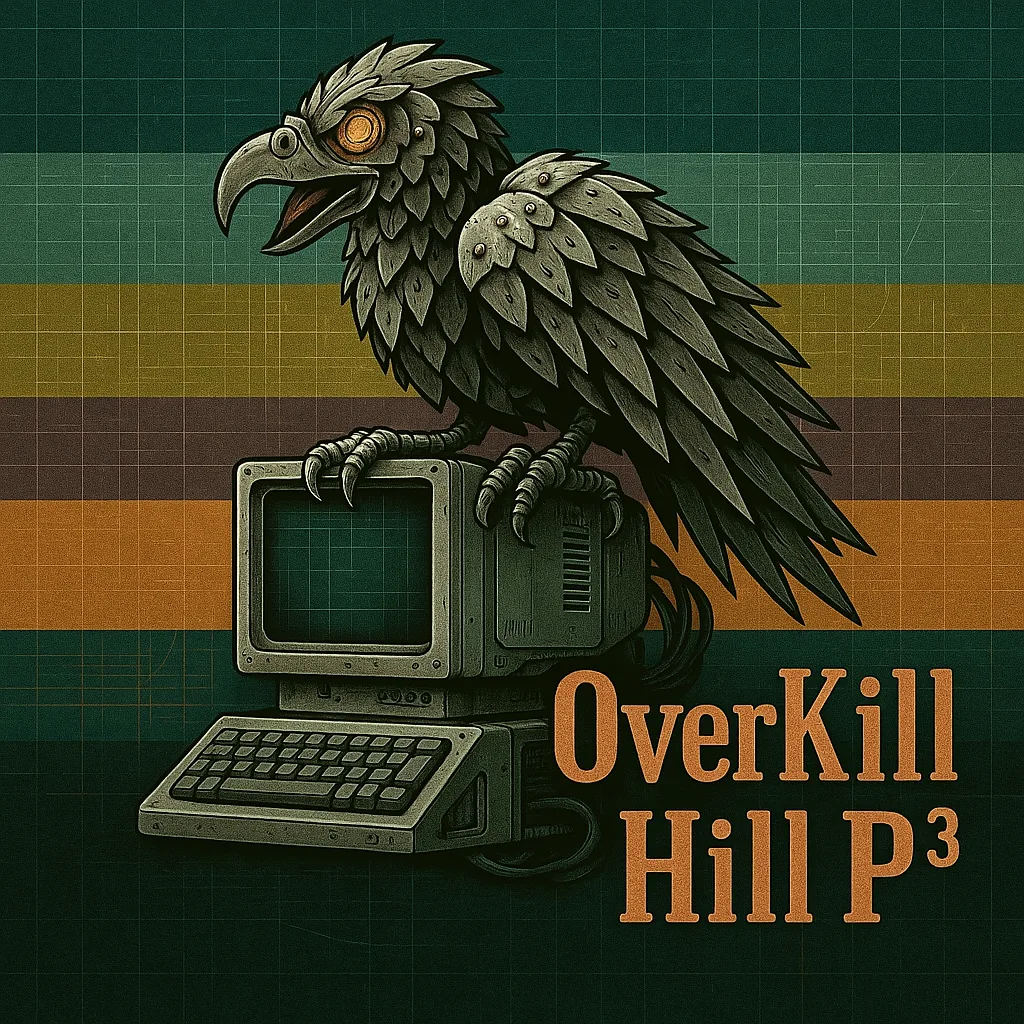
I started by returning to MurderBird artwork I had made more than a year earlier. The tools had moved forward. I wanted to see how much further I could take the detail, the materials, and the character itself. That became a second generation of images. Those images led to videos. The videos made me wonder what MurderBird should sound like.
By the time there were moving images, lyrics, and a song, another question had arrived: if I were in middle school or early high school today, what would I want to bring to the science fair?
A mechanical creature you could walk around, look inside, and interact with sounded like a good place to start.
Art → motion → music → encounter
Revisit the image
Repaint and rework the original art with newer generation tools and more specific direction.
Make it move
Use the images to explore timing, weight, mechanical movement, and short video scenes.
Give it a sound
Turn my listening preferences into a musical brief, then develop lyrics, an arrangement, and an AI-sung theme.
Make it explorable
Bring the visual and musical work toward an interactive 3D display with a body visitors can inspect.
The same character. A more demanding brief.
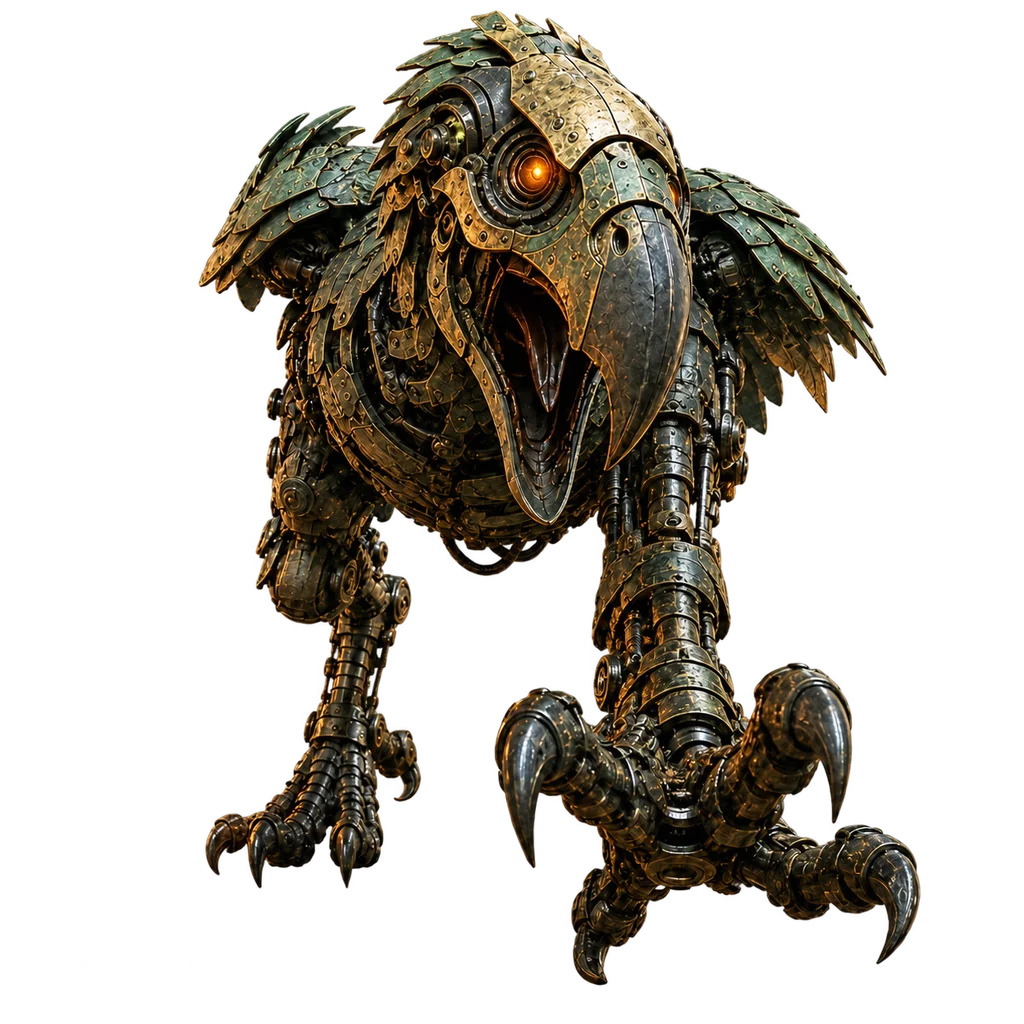
Many of the second-generation images were created with OpenAI’s latest image-generation tool at the time of the work. I directed the rework at the keyboard: what to retain, what to change, and what needed another pass. The ambition was to bring the older art forward with more convincing detail and better control over the result.
That required decisions more useful than “make it more realistic.” The bird needed a consistent silhouette. The armor needed to read as fabricated metal. Old bronze, later repairs, and modern additions needed different surfaces. A character that looked right in one image still had to hold together in the next.
The prompt became a set of decisions.
Earlier preserved image briefs separated anatomy, materials, lighting, composition, and the changes allowed in a revision. Each reference had a job. One could supply proportions while another supplied the palette, without asking the model to copy everything from both.
Inside an earlier image-edit prompt
“Change only the MurderBird's remaining modern-raptor anatomy and the mechanical action of its pose. Keep every successful environmental, material, lighting, and brand-quality element of Image 1.”
This excerpt comes from the July reference-master record, which documents OpenAI native image generation. It shows how the revision method developed; the exact underlying image-model version is not recorded.
What I was learning: art direction through constraints, continuity across images, and how to correct one failure without throwing away the parts that worked.
A convincing still has nowhere to hide when it moves.
The new images became the starting point for video experiments in Adobe Firefly, with GPT-5.6 SOL helping drive the workflow. Motion introduced a different set of problems: where the weight goes, which joint moves first, what stays fixed, and whether the action has a visible cause.
The First Choice pilots made that concrete. One version moved the feet when they should have stayed planted. Another moved the entire stand when only its saddle should turn. The correction became specific: anchor the base and shaft, keep both feet planted, then let the torso shift and the head lower in response.
What I was learning: movement direction, continuity over time, and how to turn “that looks wrong” into a correction the next attempt could actually follow.
What does MurderBird sound like?
Watching the bird move led me back to the music I enjoy. I used my Apple Music favorites to assess the styles and bands I kept coming back to, then shaped that into a direction for MurderBird: melodic, guitar-led rock with weight, tension, and room for a deliberate arrival.
From there came lyrics based on the story, composition, and the work of turning that direction into a song. The resulting theme is Iron Verdict.
None of the singing is my voice. I drove the work at the keyboard, using AI and production tools to develop the material, hear the results, and keep moving it forward.
- Establish the musical language. Listening preferences became an original creative brief. The early production record describes newly written notes and locally synthesized sounds, without sampling the reference artists.
- Build an arrangement that could be edited. The first instrumental used a D-centered minor score at 104 BPM, MIDI, and aligned audio stems. GarageBand supplied a separate instrument interpretation of the six-track MIDI arrangement.
- Make the vocal direction explicit. Lyrics, a notated melody, MusicXML, MIDI, a pitch guide, and a rehearsal mix made phrasing and timing inspectable. Those guides were intermediate production material.
- Generate and finish the sung version. The accepted version used ACE-Step 1.5. Demucs, local audio processing, and FFmpeg supported separation, finishing, encoding, and checks. The delivery includes a full song and a repeating exhibit mix.
Listen to Iron Verdict
The accepted AI-sung version. Press Play to start.
What I was learning: translating taste into musical direction, arranging parts, specifying vocal phrasing, working with stems, and distinguishing a useful guide from a finished listening version.
What would I build if I were that kid today?
Thirty-five or thirty-eight years after middle school and early high school, I started thinking about the project I would want to make with today’s tools. The images, videos, and music had already given MurderBird a presence. An interactive display could give someone else a way to investigate it.
That meant moving into 3D: a body with parts, joints, and an interior. A visitor could inspect how the machine changes across three eras, open assemblies, and see different ways of moving. The science-fair idea gave the separate experiments a shared destination.
Blender became the working environment for editable model studies. Named rigid assemblies and GLB exports carried that work into the browser exhibit. The materials now include surface studies and articulated versions, with comparison views to judge them against the reference art.
The exhibit is published for assessment. I am still refining likeness, proportions, armor, and character movement. The current 3D interpretation is a working study.
Which tool did which job?
| Tool or method | Its place in the work |
|---|---|
| OpenAI image generation | Many of the second-generation images: new generations, repainting, and targeted rework. The exact image-model version is not recorded. |
| Reference images + revision prompts | Separate visual identity from anatomy, materials, and composition; name what must survive the next edit. |
| Adobe Firefly + GPT-5.6 SOL | Video creation in Firefly, with GPT-5.6 SOL assisting the workflow. Pilot review focused on contact, timing, and mechanical cause; the exact video-model selection is not recorded. |
| Apple Music favorites | Source material for identifying my musical preferences and writing the sound brief. |
| MIDI, synthesis + GarageBand | Original instrumental composition, editable arrangement, aligned stems, and an alternate instrument rendering. |
| ACE-Step 1.5 | Generate the accepted sung theme from the project’s lyrics and musical direction. |
| Demucs + FFmpeg | Support audio separation and finishing, listening formats, loudness measurement, and repeat-loop delivery. |
| Blender + GLB | Editable 3D studies, articulated assemblies, surfaces, and exports for an interactive display. |
| GitHub | Keep prompts, source material, revisions, and production records connected as the project changes. |
The exhibit runs on Vite, Three.js, and Web Audio. Its repository maintains the application details alongside the creative production archive.
The useful part was learning to direct the next attempt.
Each stage demanded a more precise vocabulary. Images required anatomy, materials, and lighting. Video required timing and weight. Music required arrangement and phrasing. A 3D display required parts that could move and still belong to the same body.
The skills growing through this project are practical: writing better visual briefs, maintaining continuity, diagnosing a failed generation, composing and arranging with AI, and carrying an idea between tools without losing its identity.
There is still work to do. The next measure of progress is how closely the model and its movement match the character I have been directing all along.
The artifacts behind the progression
- Media catalog: images, motion, music, and model studies.
- Instrumental production notes: arrangement, synthesis, GarageBand, and stems.
- Model production handoff: editable sources and the current studies.
Project account updated September 27, 2026. The MurderBird story and manifesto remain the places to read the fiction and its meaning.
Created and directed by Jamie Hill / OverKill Hill P³. MurderBird creative content is all rights reserved; application code is MIT-licensed. Read the content and code notice.