
Want to inspect the evidence first? Start with the criteria and scoring lanes, compare the first-pass diagrams with the revisions, then read where the Council agreed and split. These findings describe this sample. The version history puts the experiment in context.
Read the story. Work through the idea.
Before you settle into the long version, you have a choice. Read the argument here, or visit Diagram Truth, the project doorway to the interactive field guide. From there, start the five-step tutorial or jump into the Draw the Truth workbench. The story explains the argument; the application gives you somewhere to practice it. OverKill Hill is home base for both, with the related projects and evidence connected around them.
The application was created using Replit. That sentence still makes me smile. I began with a question about diagrams and ended up with a working single-page application that lets somebody explore the argument instead of only reading my explanation of it. Replit became one of the unexpected discoveries of this project: a way to turn a written idea into something a reader could actually operate. The implementation and subsequent improvements are maintained in GitHub, and the public application is hosted on GitHub Pages.
I didn't arrive with that destination neatly plotted. The route ran through Mermaid, competing AI interpretations, visual preferences, reusable Agent Skills, and the realization that a useful explanation could have controls. Somewhere along the way, the project stopped being only about making a better picture. It became an education in tools, methods, and skills I hadn't known to look for when I started. I'm excited by what I built, and by how much my own sense of what I could build changed while building it. That's a rabbit hole I'm glad I went down.
The field guide gives that exploration a practical shape. Identify the kind of lie a tidy diagram might be telling. Adjust the illustrative ROY inputs and consider what clarity costs. Compare a clean forward path with a revision that exposes its loops. Explore a reusable visual-preference profile. Examine structured disagreement, then assemble a handoff for the next person. You can move between those activities without reading the whole essay first, and return to the longer explanation when a question deserves more space.
Try it with one process you know well. Name the exception that always gets explained in a meeting but never makes it into the diagram. Notice whether changing the view helps you describe that exception more precisely. Then bring the question back to the article's evidence and operating method. The application offers a place to rehearse the thinking; the article supplies the context and qualifications. Its sliders are illustrative, and its teaching diagrams aren't a general-purpose Mermaid editor.
This is the loop I want the project to support: read, interact, question, return, and improve. Someone arriving through LinkedIn can find the interactive route. Someone discovering the application can return to the story. Both should lead back to OverKill Hill, through the story and the Diagram Truth project page, where the related projects and their context stay connected. Choose the form that helps you understand the work, then switch when another form would help more. A long article can explain why the first diagram lies. An interactive infographic can give you somewhere to practice catching it.
The cost of a tidy lie
A diagram is a claim about how reality is structured. Every box says something exists. Every arrow says a relationship matters. Every missing exception makes a promise the author may never have intended to make. That is a lot of authority for a picture that somebody generated between meetings.
The first diagram often looks resolved before the thinking has earned that confidence. The handoffs are smooth. The decisions have two convenient answers. Nobody is absent, the evidence arrives on time, and the process proceeds from start to finish with the optimism of a sales demonstration. Then somebody who actually does the work points at the middle and says, “That isn't what happens.” Now the useful work can begin.
This article follows a small diagramming experiment into a larger business question: how can we make shared understanding easier to inspect, challenge, and maintain? I used several AI systems to help describe the process of writing a post about diagrams, turned their structured text into Mermaid diagrams, compared the submissions, and asked for revisions. The resulting archive preserves both rounds, the prompts, the pictures, and the compromises. I call the method a Council of AIs because comparison and human adjudication were deliberate parts of the exercise.
The experiment is a practitioner case study. It provides artifacts to examine and a record of my judgments. It does not establish a universal ranking of models or a measured productivity gain. Those boundaries matter because the business proposition is easy to inflate: cheap diagrams, therefore cheap understanding. The second does not automatically follow from the first.
My argument is that inexpensive generation makes disciplined review more valuable. A team can spend less effort constructing a picture and more effort checking whether it carries the right meaning. To sustain that benefit, the picture needs an underlying record of decisions, exceptions, authority, and evidence. Otherwise we have accelerated the production of documents that will become stale in exactly the familiar way.
The route through the argument is practical: define what understanding is worth, examine what the two diagram rounds actually show, turn the lessons into a proportionate working method, and maintain the knowledge behind the boxes. The corporate application proposed later uses an illustrative purchase-request process. It is a worked example, not a reported client implementation. The finish line is an artifact a reader can use correctly and an owner can update responsibly.
The translation and reconstruction tax
I've been drawing pictures on computers since the early 1990s. AutoCAD meant a black screen, commands, coordinates, and the concentration required to construct an idea line by line. Since then, I've used diagrams for house plans, networks, process flows, mind maps, organization charts, UML, and database relationships. Enough time in Visio probably qualifies a person for some sort of emotional settlement.
The recurring expense was translation. I could understand a relationship and still spend considerable time persuading a tool to show it. Pick the shapes. Route the lines. Fix the alignment. Move a box, discover what else moved, and remember what the box was supposed to mean. The mechanics of presentation competed with the reasoning the presentation was meant to support.
That production effort encouraged a particular habit: finish the thinking in prose, then commission the diagram as the polished summary. It made visual work feel expensive to reopen. A diagram that had consumed an afternoon acquired a strange protective aura. People were reluctant to disturb the layout even when the underlying process deserved disturbing.
The reader pays a second expense. Prose presents information in sequence, while many business problems depend on relationships across that sequence. A reader has to hold the owner from one paragraph, the exception from another, and the approval condition from a footnote in memory at the same time. Two competent people can reconstruct two different processes from the same document.
The familiar symptoms follow. A “quick summary” needs a meeting. An approval note produces another round of clarifying email. A procedure is technically complete, but its branching logic is difficult to find. The author has transferred the work of assembling the model to every reader.
A useful diagram can bring related conditions into view together. That advantage depends on the task and the design. A diagram can also bury a condition in a tiny label, turn a nuanced rule into an ambiguous diamond, or imply a sequence that the source never established. The medium is an opportunity to expose structure; it still requires judgment.
Larkin and Simon's research on diagrammatic problem solving offers a useful conceptual foundation. Their analysis distinguishes equivalent information from equally efficient use of that information. How a representation groups relevant elements can affect the search and inference needed to solve a problem. That helps explain why a visual arrangement may be useful without assuming that pictures always outperform prose. Their work is not a validation of this experiment or of a new business metric. Research: diagrammatic representation
For a business team, the question should therefore begin with the reader's task. Must a new analyst route an exception? Must a manager identify a dependency? Must an executive choose between options with different consequences? “Make this visual” is an incomplete brief. “Help this reader make this decision with these facts” gives the author something to optimize and the reviewer something to challenge.
This also changes how we handle detail. A senior sponsor may need the boundary and the consequence; an operator may need the missing-input rule. Both can use views of the same process record. Compressing everything into one executive slide usually makes the operator reconstruct the details. Expanding everything into one wall-sized diagram often makes the executive abandon it.
The communication problem is to choose a useful view while keeping the omitted knowledge reachable. That is where the economics of words, diagrams, and revision meet.
ROY: what did the words buy?
ROY means Return on Your Words. I use it as a heuristic for useful understanding relative to the total effort invested in explanation. It asks a simple question: did this explanation remove enough confusion to justify creating, reviewing, using, and maintaining it? The return is understanding. The investment includes more than the prompt.
A short prompt can produce a large diagram whose review consumes an hour. A carefully written paragraph can prevent that hour. Conversely, a small visual can make a tangled dependency understandable without requiring every reader to reconstruct it from several pages. Word count can expose waste, but it cannot settle the value of the communication.
Earlier artifacts in this project explored several ratio metaphors. Those formulas remain visible in the original diagrams as part of the experiment. The interpretation used here is deliberately consistent: ROY is a thinking aid, not a validated quantitative index. There is no scientifically established exchange rate between a word, a minute, a misunderstanding, and a business decision in this case study.
That distinction prevents some appealing arithmetic from becoming misleading. We should not add “words avoided,” “mistakes prevented,” and “decisions accelerated” into one score unless we have defined and justified the conversion between them. We should also avoid saying that a ratio of positive quantities becomes negative. A separate net-benefit calculation can be negative when costs exceed benefits. The metaphor should not get a promotion to mathematics because it looks good in a callout.
Here is how I would make ROY useful in a team. First name the task: for example, correctly route a request that arrives without required evidence. Then name the readers and the baseline they currently use. Decide what a correct answer must contain, including the exception and its owner. Compare the existing explanation with a revised one while tracking reader accuracy and the effort needed to create and review the revision.
The diagram earns credit when it improves that task. A shorter reading time accompanied by more incorrect decisions is a failure. Fewer questions accompanied by silent confusion is also a failure. A document that looks concise because readers give up has optimized the wrong variable.
For ordinary operational work, four observations are often more useful than an impressive composite score: whether readers choose the correct route, whether they recognize the important exceptions, how long the task takes, and how much correction or guided explanation they require. Preparation and maintenance effort belong beside those observations, so the author cannot make a solution look efficient by transferring costs to another person.
Consider the audience size and useful life as well. A laborious one-time diagram for one familiar decision may never repay its creation cost. A carefully reviewed process view used repeatedly by new staff may justify substantial effort. Neither result follows from the number of nodes. The context determines which investment is sensible.
An optional business calculation can express net time benefit over a named period: reader and rework time avoided, minus additional author, reviewer, and maintenance time. That is a proposed accounting approach. Teams would need their own observations, rates, and assumptions to translate it into money. This article supplies no invented percentage saving and no claim that the original Council exercise measured financial return.
ROY also has a useful editorial consequence. A sentence must contribute enough to deserve the reader's attention. Sometimes a short standalone line does more work than a dense paragraph. Sometimes a detailed explanation earns its length because removing it would hide a condition. Compression is successful when it removes unnecessary reconstruction while preserving the knowledge the task requires.
That rule applies to this article as much as to the diagrams. A long piece has to teach a method, expose its limitations, and make its evidence accessible. Length is an allowance, not an achievement.
When the diagram became text
During the initial exploration, ChatGPT returned structured diagram syntax while I was describing a process. I asked what it was. Mermaid. That encounter changed my working habits because I could describe relationships in text and render a visual from them. Iteration became closer to editing a specification than rearranging furniture on a canvas.
Mermaid is a diagramming language and renderer. An AI system can help write its source; a person can write the same source by hand. The distinction matters whenever we evaluate the output. The model proposes structure and labels. The renderer turns the source into a visual. The surrounding product supplies its own interface, configuration, permissions, and constraints. A success or failure can originate at any of those layers. Mermaid documentation
The practical shift is that relationships become editable source. Change a label, inspect a decision, compare revisions, retain the original, and render again. A source file can travel through version control and review. It becomes easier to ask what changed than it is with a screenshot alone.
Suppose the source describes a request moving from submission to review, then to either approval or a return for more information. A reviewer can inspect the condition attached to the decision. If the return route is absent, the omission is available for discussion before anyone spends an afternoon refining colors. The visual and the source reinforce each other: one makes relationships easier to see, the other makes them easier to inspect and change.
This lowers the penalty for an imperfect first attempt. A team can expose a rough model early, find a missing actor, and revise the source. The review conversation becomes more specific because people can point to the relationship they dispute. “This feels wrong” can become “requests without evidence must return to the requester before the approval check.”
Rendering is only the first check. I distinguish four questions. Does the source render? Does the structure faithfully represent the supplied facts? Can the intended reader use it correctly? Does its use improve the relevant work? Passing one question does not answer the next. A technically valid diagram can be operationally wrong, and an accurate diagram can still be difficult to read.
The first generated picture often fails at the second question. It tidies up uncertainty. It selects a plausible route where the source left a gap. It makes a process look linear because a linear process is easy to express. The appropriate response is to inspect the implied claims, not to add more loops until the image looks sophisticated.
Every loop should have a reason to exist. What condition sends the work back? Who handles it? What changes before another attempt? Where can the process stop? A decorative loop is the same problem as a decorative box: apparent complexity without useful explanation.
Text source also has limits. A short node label cannot carry a complete operating procedure. Renderer behavior and styling need checking in the destination. Source control records edits, but it does not automatically record why an operator accepted a change. Those responsibilities need an accompanying process record and a human owner. Mermaid makes that arrangement easier to maintain; the arrangement still has to be designed.
How the Council experiment was run
The exercise began with a deliberately recursive brief. Produce a thesis about the value of diagrams, write a LinkedIn post about that value, and create a Mermaid diagram showing the ideation process behind writing the post. The diagram had to acknowledge the forks, revisions, and dead ends that a neat production story would usually remove. The communication was also supposed to demonstrate its own argument.
The governing brief and archive preserve the working materials. This was an exploratory exercise that evolved while I learned, rather than a controlled benchmark designed in advance. Its conditions should be visible before its selections are discussed.
The Core Five were ChatGPT, Claude, Copilot, Perplexity, and Gemini. The recorded conditions identify Gemini as a free-tier participant and the other four as paid-tier participants. They shared the central challenge, but that does not make their product access identical. The archive's older sentence about equal paid access is inconsistent with its detailed table; the table's disclosed difference governs this account.
Notion and Replit belong in the Specialty group. Notion's contribution included consolidation and custody of the work. Replit entered later with accumulated context and a build-environment perspective. My own familiarity with Replit was still developing. A late participant with more context and an unfamiliar interface presents a different condition from a fresh response to a common prompt.
ChatGPT V2 Pro is an Exhibition entry. Its additional capability access should remain visible rather than quietly joining a supposedly equivalent comparison. Mermaid.ai is recorded as an Attempted workflow. The attempt was useful for thinking about workflow design, but it is not an equivalent completed competitor in the final field. These four categories preserve the distinctions that a single leaderboard would erase.
There are fifteen diagram records in the preserved field: seven V1 entries and eight V2 entries, including the exhibition variant. The presentation deck has eighteen slides. Those counts describe different things. A slide is not necessarily a distinct submission, and a rendered image is not a new experiment merely because it has been exported at another size. The diagram manifest connects entries to their sources and renders.
V1 and V2 mean the two diagram rounds throughout this article. V1 denotes the first archived competition submission for an entry, which may already reflect prompting or steering. V2 follows exposure to peer work and further instruction. It would overstate independence to describe V2 as another cold start. Comparison was part of the intervention.
The working sequence was fan out, compare, adjudicate, and synthesize. Multiple initial outputs made different interpretations visible. Peer review and revision exposed additional options. I then made human judgments about which elements were useful. A synthesis in this setting is an edited combination of contributions, not evidence that a committee automatically produces the best possible answer.
Three evaluation lanes developed. My architect judgment selected artifacts. Council-assisted review examined the submissions against the rubric. Audience polls invited public response. These lanes answer different questions and have different weaknesses. They should not be combined into one authority simply because all three used the word “evaluation.”
My recorded architect selections were Copilot V1 for Round 1 and Claude V2 for Round 2. Those are judgments within this exercise. The archive also contains narrative summaries of Council scoring, but the inspected record does not supply the original seven-criterion numeric matrix needed to reproduce every exact consensus claim. I therefore avoid presenting precise vote splits or self-score comparisons as independently reproducible findings here.
The rubric is still useful as a review aid. It invites examination of clarity, structure, honesty about the process, and the contribution of visual choices. Its presence does not transform a judgment into a validated measure. A reader can inspect the outputs, disagree with my selections, and identify a stronger explanation. That possibility is part of the point of preserving the artifacts.
The prompts are equally important. A normalized brief helps a later reader understand the intent, while the actual prompt sequence shows how the exercise developed. Those records should remain separate. If a roster, instruction, or scope changed, a clean retrospective must disclose the difference rather than quietly rewrite the old prompt to match the final story.
Finally, participant names identify the systems used in this case. They are not enduring personality types. A restrained paragraph and an elaborate diagram can come from the same product. Model versions, interfaces, access tiers, prior context, and instructions can change. The useful question is what a particular submission did under its recorded conditions.
What the two rounds actually reveal
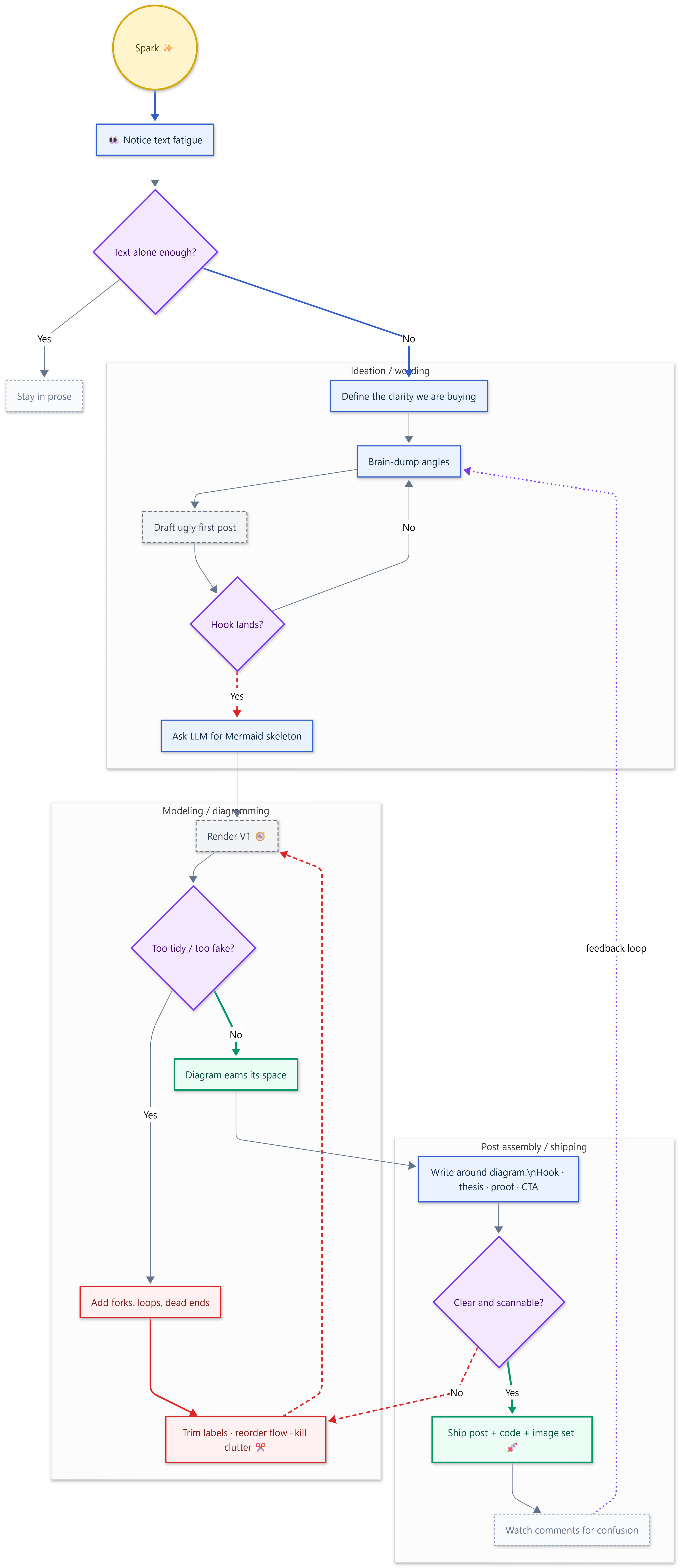
Copilot V1 earned my first-round selection because it makes several consequential choices visible. It starts by asking whether text alone is enough. One branch allows the work to remain in prose. The other proceeds into defining the clarity being sought, developing an angle, drafting, rendering, and checking whether the result is too tidy. A return loop sends the author back through revision. Feedback after publication returns to the earlier thinking.
That opening decision is easy to overlook. A diagram about the value of diagrams includes a legitimate route that avoids making one. It treats the medium as a choice conditioned on the task. For a corporate reader, that is a more useful starting point than assuming every process deserves another visual.
The diagram also separates ideation, modeling, and post assembly into recognizable areas. That gives a reader landmarks. Its decision labels and return paths help explain where correction happens. In practical terms, it exposes enough of the working process to invite a specific critique rather than asking the audience to admire an attractive summary.
One historical distinction deserves careful wording. An earlier five-entry source capture gives Copilot explicit theme configuration that the other captured entries did not supply. Later archived V1 files all carry configuration headers. These are different source stages. The earlier capture supports a bounded observation about Copilot's submitted configuration; the later headers do not establish who originally chose every setting or how each export was normalized.
That is a small archival detail with a large methodological consequence. If we compare altered exports while believing they are untouched submissions, we can attribute the renderer's presentation or an editor's normalization to the model. Keeping the source-to-render relationship visible protects the interpretation. It also gives the next person a chance to correct it.
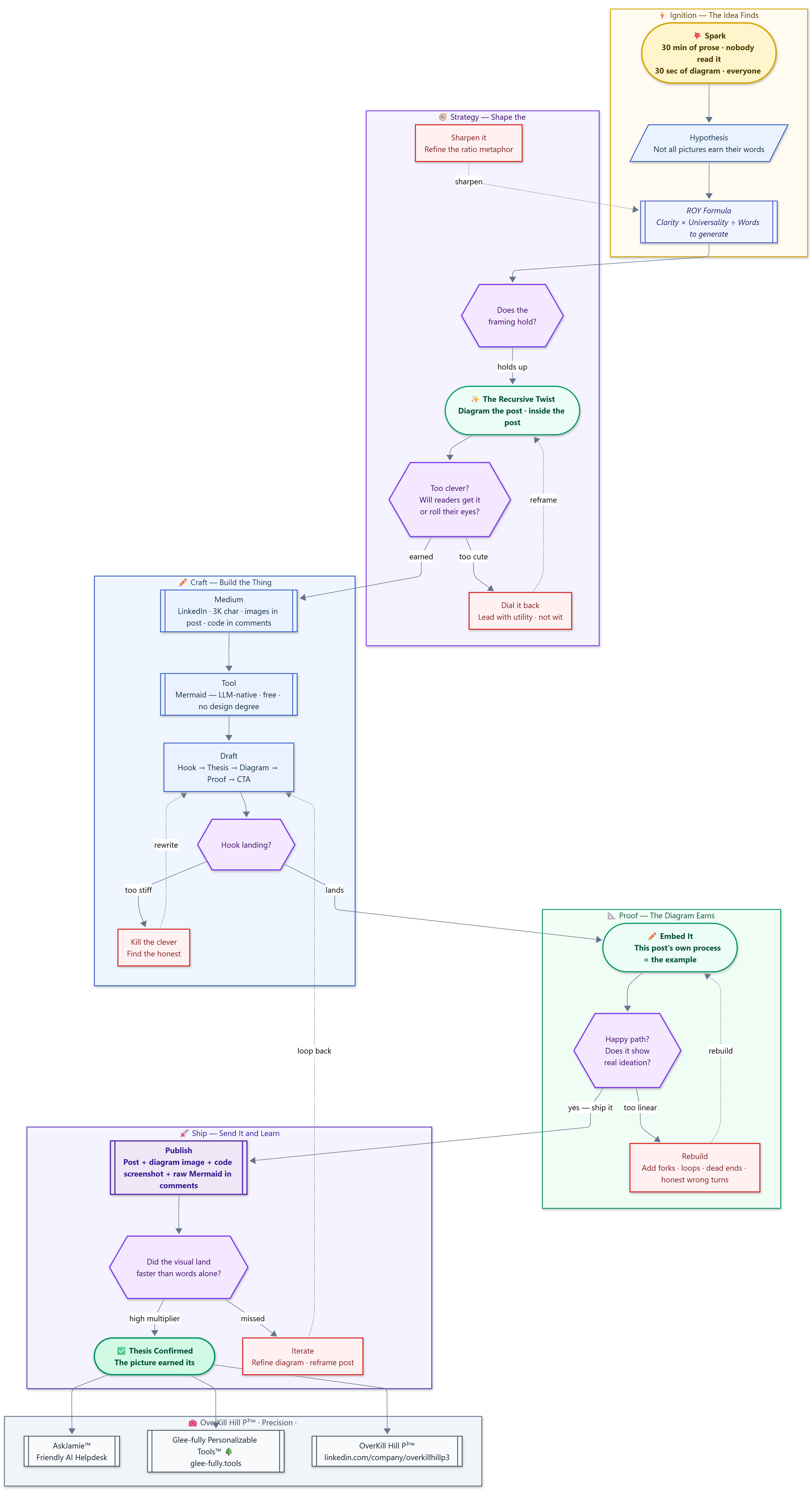
Claude V2 earned my second-round selection for its narrative organization. It groups the work into ignition, strategy, craft, proof, and shipping, and makes several return paths conspicuous. The structure is easy to discuss as a sequence of concerns: establish the idea, test the framing, build the artifact, challenge it, and learn from use. That hierarchy helped me see the argument as an organized whole. Selection did not make it flawless.
The preserved Claude V2 source contains a revealing regression. A decision asks whether the framing holds. Its positive route continues, but the negative route into the nearby “Sharpen it” activity is missing. That activity still points back toward the framing. In the archived Claude V1 source, the decision explicitly connected to the sharpening step when the framing was too abstract. Revision improved the presentation while losing a meaningful route.
There is also a compound decision about whether the diagram is a happy path and whether it shows real ideation. Those questions can have opposite answers. A single yes/no branch becomes ambiguous. Adding more visual sophistication has not repaired the underlying decision sentence. A reviewer should split the question or rewrite it so each outgoing route has one clear meaning.
The original includes rhetorical quantities and conclusions as well: an example contrasting minutes of prose with seconds of diagram, a variant ROY formula, and a node declaring the thesis confirmed. Those labels belong to the historical artifact. They are not measurements or conclusions established by this article. Keeping an original intact requires a caption that explains its limits, especially when the original itself is overconfident.
These two examples support a narrower and more useful conclusion than an overall winner. Comparison made different strengths and defects available for inspection. My selection reflected the aspects I valued at that moment. Later scrutiny can find problems that the selection missed. A transparent archive makes that correction possible without pretending that the original judgment never happened.
The model interview material needs the same treatment. Retrospective explanations can suggest a useful reading of an artifact: why a hierarchy helps, where a label became overloaded, or what a revision appears to emphasize. Some published interview passages were paraphrased composites, and parts of the editorial source were reconstructed in a model's voice. They should be understood as interpretations, not privileged access to the original generation process.
An explanation can also be factually wrong about the picture it describes. A retrospective may say that V2 introduced a feature already present in V1, or assign a V2 phase name to the first round. The correct response is to inspect the exact source and render. Fluent self-critique is still a claim. It needs the same checking we would apply to a confident human commentary.
The audience response provided another lesson in limits. My published campaign account reports 1,735 poll impressions and five votes. That is approximately 0.29 votes per hundred impressions. It is a sparse participation signal. It is not a representative preference result, and impressions do not identify a deduplicated group of people moving through a tracked conversion journey.
Friction is a plausible explanation for low participation: asking readers to inspect a deck, compare diagrams, and vote requires effort. Relevance, timing, audience composition, visibility, and simple lack of interest could also matter. The campaign did not isolate those causes. The practical lesson is to design an evaluation around the decision and effort expected from participants, then collect evidence appropriate to the claim you intend to make.
Across the artifact review, interviews, and audience response, the same discipline recurs. Keep the observation separate from its interpretation. Say what the evidence can support. Preserve enough detail for someone else to challenge the conclusion. That is how an experiment becomes reusable business knowledge instead of a polished story about an experiment.
Turn disagreement into a working method
The corporate method I would derive from this case is deliberately modest. Use alternative representations when they may expose a consequential omission. Give reviewers specific responsibilities. Preserve the reasons for accepting or rejecting changes. Validate the result with the people who need to use it. Then stop when further generation no longer justifies its cost.
This is a proposed operating method informed by the case, not a process whose business outcomes were measured in the original exercise. It can be piloted within an existing documentation practice. It does not require a new department, a new committee, or seven models in every meeting.
Start by deciding whether comparison is warranted. It is most useful when the process has unclear handoffs, meaningful exceptions, competing interpretations, or consequences that make a plausible omission expensive. A familiar sequence with an agreed owner and straightforward acceptance criteria may need only a short explanation and a normal review. The number of available AI systems is a poor reason to expand the review budget.
For an uncertain workflow, establish the decision the artifact must support. A process owner should be able to complete this sentence: “The intended reader must be able to do this correctly, using this information, within these boundaries.” If that sentence is still vague, generating alternatives will multiply the vagueness.
Then assign accountability. The subject-matter expert confirms how the work is actually performed. The author or analyst captures and models it. Reviewers challenge different aspects of the artifact. The domain owner adjudicates consequential disagreement. The document owner maintains the approved record. A small team can combine roles, but someone must be accountable for each decision. Here is the sequence I would use.
- Frame the task. Record the audience, scope, cost of error, known uncertainty, and the decision to support. Decide what is outside the model so omission is explicit.
- Capture the source. Write a process narrative with actors, inputs, rules, outputs, exceptions, evidence, and unanswered questions. Ask the person who performs the work to confirm it.
- Produce a first model. Link each consequential task and decision to the source record. Check that the diagram renders and that the labels mean what their arrows imply.
- Challenge the model. Separate factual fidelity, reader usefulness, and implementation boundaries. Reviewers record observations and proposed corrections before seeing one another's conclusions where practical.
- Adjudicate. Resolve differences using a source, a domain decision, or a targeted test. Record rejected suggestions as well as accepted ones when the distinction matters.
- Validate with readers. Give representative tasks and exceptions to intended users. Observe what they do without rescuing every hesitation with a guided explanation.
- Publish and maintain. Release the accepted view together with its source, owner, date, limits, and change triggers. A process change reopens the relevant checks.
The useful output from a reviewer is specific. “This is clearer” is a preference until we know what became easier to understand. “The missing-evidence route ends at approval because the return condition is absent” identifies a defect that can be tested. A reviewer should point to the node, the source statement, the consequence, and the smallest correction that resolves it.
A comparison should also preserve dissent. Suppose two reviewers agree on a tidy route and a third points out that the approving manager can be absent. The majority does not decide whether absence occurs. The source and the process owner do. If an exception exists, the diagram needs a route or a clear link to where that route is explained.
Reviewing with different AI systems may expose different suggestions, but shared training patterns and similar prompts can still produce correlated errors. Separate outputs are not a guarantee of independent knowledge. Human reviewers can also share an assumption. The operating method therefore needs a route back to evidence, rather than treating agreement as proof.
A narrow counter-review can be valuable when everyone agrees too comfortably. Ask for a plausible case that would make the conclusion fail: missing evidence, an unavailable actor, contradictory criteria, a stale threshold, or a reader who follows the diagram literally. Require the critic to say what would disprove the objection. Otherwise disruption becomes theatre and consumes attention without improving the artifact.
There is a stopping rule and a failure rule. Stop when consequential disagreements are resolved, the predeclared reader tasks meet the acceptance conditions, and another review pass produces only stylistic variation. If a consequential fact is unresolved, the intended reader takes the wrong route, or the effort cap is reached, defer acceptance. Escalate the factual question to the named process owner, narrow the scope, or return to the source capture. Exhausting the budget does not convert an unknown into an approved fact.
For a pilot, the owner can set a fixed review window and a maximum number of revision rounds before work begins. Those values are management choices, not thresholds validated by this experiment. Their purpose is to prevent endless polishing and to make the cost of additional review visible. A high-consequence ambiguity may warrant more investigation; the owner should make that decision explicitly.
The same rule applies to automated councils. Product features can help expose different outputs and organize synthesis. Perplexity's Model Council announcement, for example, describes visible disagreement and side-by-side outputs as well as synthesis. My preference for direct human adjudication is a workflow choice. It should not depend on claiming that an automated product necessarily hides disagreement. Provider announcement
The lasting business capability is the review discipline. A team should be able to explain why it used comparison, what it learned, who made the consequential decision, and what would cause the accepted result to change. That explanation should survive a change of model or platform.
A purchase request, followed all the way through
Consider an illustrative internal purchase-request process. It has a requester, a reviewer, and an approving authority. This is a constructed example for explaining the method. It contains no employer-specific policy, client data, measured savings, or claim of a deployed workflow.
The first picture is familiar: submit the request, review it, approve it. It looks complete because every box has a verb and every arrow has a destination. Yet the middle box has absorbed almost all the operational knowledge. What makes a request reviewable? Who can approve it? What happens if the evidence is missing? What if the assigned authority is unavailable? Can the requester approve their own request?
The source narrative should answer those questions before the picture invents answers. Give the submission step an identifier such as REQ-01. Record the required inputs in a locally approved policy reference. Give the completeness check an identifier such as DEC-01. Its two outcomes are complete enough for assessment, or returned for clarification. Define what information accompanies a return so the requester can repair the deficiency.
Give the approval-authority check a separate identifier, DEC-02. It asks whether the assigned person has authority under the applicable rule. The rule itself lives in the narrative or linked policy. A diagram label is a poor home for a long or frequently changing delegation table. The visual can show the decision and link to the rule without pretending the rule is obvious.
Keep the record explicit about uncertainty. If no source establishes the route for an unavailable approver, write “escalation route requires owner decision.” Do not ask an AI model to choose whichever route sounds like professional practice. A plausible control is still a new control. It may conflict with the organization's actual authority structure.
The first model now has a real chance of being useful. Submission leads to the completeness decision. Incomplete requests return with a reason. Complete requests proceed to assessment and the authority check. The process ends only when the chosen disposition has been recorded and communicated. Rejection, clarification, and approval have different meanings and should not disappear into one generic “done” box.
Assign three review concerns. A fidelity reviewer checks the model against the narrative. A usability reviewer checks whether labels and branching make the intended task clear. A controls reviewer checks whether the artifact implies authority or access that the record does not grant. These are responsibilities, not a prescribed number of people or products.
Suppose one review proposes combining the completeness and approval decisions to make the picture shorter. Another points out that a complete request can still lack approval. The adjudicator rejects the combination because it changes the meaning of the route. The record can be brief: “Keep DEC-01 and DEC-02 separate; completeness permits assessment, not approval.” That sentence prevents the next cleanup pass from reintroducing the same mistake.
Suppose another review proposes automatically escalating to the reviewer's manager. The narrative does not establish that manager's authority. This proposal is deferred to the process owner. The diagram remains a candidate until the owner identifies an authorized route or narrows the supported scope. A red warning shape may expose the gap, but it cannot resolve the organizational decision.
Once the owner has confirmed a route, validation can use ordinary cases and exceptions. Ask an intended reader to handle a complete request, a request missing evidence, a request outside the assigned approver's authority, and a case where the normal approver is unavailable. The reference answers come from the approved narrative. The test should examine the destination and the reason, so a lucky click does not look like comprehension.
A reader who routes missing evidence directly to approval has identified a material problem. Check whether the source is wrong, the diagram is ambiguous, or the task itself was poorly specified. Revise the relevant component and repeat the affected check. Do not bury the failed case inside an average completion-time improvement.
The artifact is accepted when it meets the owner's declared correctness requirements for its scope. The publication record names the narrative revision, the diagram revision, the owner, and the remaining limitations. It also records what was intentionally omitted. Readers can then tell whether the view is an orientation aid, an operating instruction, or a proposal awaiting a policy decision.
Now change the process. Imagine the organization revises its delegation policy so a particular category requires a different approval route. The stable identifier DEC-02 lets the owner find the affected narrative rule, diagram edge, reader tasks, and related handoff instructions. Update those linked items and rerun the authority and absence cases. The identity of the decision remains stable while its rule changes.
This is where maintainability becomes tangible. A diagram that was merely an image requires someone to remember where else its meaning was copied. A linked record can make the dependencies inspectable. It still needs an owner to decide that the policy change matters and a reviewer to check the revised view. Automation can assist with finding and generating; acceptance remains a business responsibility.
The example also suggests a modest pilot question: does the linked narrative and visual help intended readers route these cases more accurately, with acceptable preparation and maintenance effort? That can be investigated without pretending the entire organization has been transformed. Start with one process whose owner can answer the questions and whose exceptions are known enough to test.
Keep the knowledge behind the boxes
The purchase-request example exposes a limitation that became increasingly important as this project developed. A task label such as “Review request” is a heading for knowledge. It does not contain the criteria, judgment, evidence, authority, escalation route, and exception handling needed to perform the task. The diagram is a view of a process record, and the quality of that record limits the quality of the view.
This is why the later work moved toward a Process Narrative Specification. The name describes a shared structure for capturing the process in enough detail to support review and multiple representations. It should hold the actors, inputs, decisions, rules, controls, outputs, measures, exceptions, evidence, and handoffs that a visual necessarily compresses.
The narrative and the diagram remain distinct representations. They can refer to the same stable identifiers and be maintained together. Regenerating an image from text does not prove that the image preserved every important meaning in the narrative. The review still has to check what was selected, omitted, and implied.
That gives knowledge custody a practical role. In this project, Notion provided an editorial home for drafts, consolidation, and the evolving record. GitHub preserved public source files and publication receipts. The article surfaces presented the argument to readers. Each had a job. Confusion arose when a working copy or historical receipt sounded like the current authority without clearly identifying its status.
A connection between tools can make reading and writing possible. It does not establish automatic synchronization, complete decision lineage, or agreement between every page. A skill can package a repeatable set of instructions. It does not guarantee that every host has the required tools, permissions, or execution behavior. These boundaries are mundane, which is precisely why they are easy to skip in an exciting demonstration.
For business use, I would make custody explicit. Name the authoritative process record. Identify the views derived from it. Record each view's owner, audience, revision, and last verification. Keep an unresolved question visibly unresolved. When a change is accepted, retain enough rationale to distinguish a deliberate decision from an accidental edit.
Replit contributed a different lesson. I initially approached it with expectations shaped by chat-based tools. Its value became clearer as I learned to use a build environment that could work with files and executable behavior. That late discovery belongs to the author's learning curve and to Replit's specialty role. It should not be retroactively described as an equal-condition victory over the original participants.
The practical question expanded from whether an answer sounded convincing to whether the work survived contact with a repository, a rendered interface, and an observable result. A running preview, a committed change, and a published application are separate states. A team needs to know which one it has. The same distinction applies to documentation: drafted, reviewed, approved, and distributed are different claims.
The BPMN for Mermaid work grew out of the question of how much process meaning a textual model could carry. The public project documents a technical prototype and a bounded descriptive subset. Alongside it, BP-SKILL supplies fifteen core Agent Skills for process-documentation work, with supplemental packages distinguished in the repository. The shared Process Narrative Specification is intended to connect capture, analysis, modeling, review, and handoff. Project and current boundaries
The near-real-time workflow I am pursuing starts with a conversation about actual work. An authorized transcript or notes become a structured process record. A visual view is generated from that record. The person who performs the work can challenge an invented handoff, a missing exception, or a misleading order while the conversation is still fresh. The record and the visual return through the same correction loop.
That complete loop remains a direction. The current project is not a claim of full BPMN 2.0 conformance, BPMN XML round-tripping, or an executable process engine. Portable instructions and a descriptive prototype should be evaluated within their actual scope. Any move toward execution introduces additional questions about permissions, decision authority, validation, monitoring, and failure handling.
For a corporate strategy audience, the larger opportunity is continuity. Knowledge often fragments between a meeting, a document, a slide, and the person who remembers why the slide looks that way. A structured record with linked views offers a way to make those relationships inspectable. It requires governance proportionate to the process and a maintenance habit that survives the original author. That is a more demanding objective than making an impressive picture. It is also a more useful one.
Make visual consistency serve the work
Once a team can generate diagrams quickly, inconsistency becomes visible quickly too. Two views of the same process may use different colors, shapes, fonts, spacing, or direction. Some differences help explain different tasks. Others force the reader to relearn a visual vocabulary without gaining new information. The picture renders, but it looks as though a different department commissioned every page.
That is the next translation tax. We reduced the effort of drawing the relationships, then spent the saving asking the agent to make them look like something we would actually use. Change the blue. Increase the labels. Keep the exceptions orange. Restore the shape it changed while fixing the font. A styling conversation can gradually become another diagramming project.
The frustration is familiar, but its cause needs separating into layers. The generating model chooses source syntax and may invent or omit style instructions. Mermaid interprets that source using its configuration and available diagram features. The destination decides which renderer, settings, fonts, and embedding behavior are available. Finally, the exported image or document imposes its own size and background. An unwanted result can originate at any of those layers.
That distinction applies whether the conversation starts in ChatGPT, Claude, Copilot, Gemini, Perplexity, or another assistant. It does not establish that they all make the same mistakes or expose identical controls. The weakness I want to address is the workflow: when preferences are missing from the active task, the assistant and renderer have to fill the gaps. A fresh conversation is a poor place to renegotiate a visual identity that the user already settled last Tuesday.
Defaults are choices too. Mermaid's current documentation describes different theme and look defaults for different diagram families and changes between releases. It also documents customization through the base theme and theme variables, including hexadecimal colors and font settings. Consequently, “use Mermaid” is not a complete appearance specification. State the intended configuration and check it in the actual destination. Mermaid theme configuration
My work on Mermaid Theme Builder grew out of that practical irritation. The project provides a workbench for applying themes to existing Mermaid source, previewing choices, and preparing exports. Its documented outputs include palette JSON, CSS custom properties, styled source, and prompt scaffolds, with examples and renderer guidance. Those are concrete ways to make a visual choice reusable. They are not evidence that every exported setting will survive every host. Theme Builder project · Documented exports
The lesson I take from that work is broader than choosing a palette. Once a person has found a useful combination of color, typography, shape conventions, and layout preferences, those decisions should become an input to the next task. The workbench helps discover and inspect the choices. A personal Agent Skill could carry the chosen rules into generation, before the first source file exists. A plugin could package that workflow for a host that supports it.
I would therefore treat Theme Builder and a personal styling skill as complementary. Use the visual workbench to decide what good looks like and inspect what the target can reproduce. Use the skill to recall that decision, select a relevant example, and constrain the next draft. Return to the workbench when the result or destination needs inspection. The aim is fewer avoidable correction turns, with the design decision made once and reused deliberately.
Consistency still has to serve meaning. In the purchase-request example, an exception should remain recognizable across the overview, the detailed procedure, and the training material. If amber means “requires attention” in one view, it should not casually mean “approved” in the next. A profile can preserve that vocabulary while allowing each view to show the amount of detail its audience needs.
The next three sections make that package concrete for someone building it. If you're deciding whether to adopt the approach, the pilot and cost checks follow under “Measure the work and keep the limits visible.”
Package the preference so the next prompt can use it
A personal styling skill could be a small, understandable package. I would give it an entry instruction, one named preference profile, examples for the supported diagram families, and a short compatibility record. Optional scripts would handle repeatable transformations and checks. This is a proposed design for the workflow, not a claim that a universal personal-theme installer has already been delivered by Theme Builder.
The Agent Skills specification provides a suitable container: a skill entry file with metadata and instructions, plus optional scripts, references, and assets. Script execution and supported languages depend on the agent implementation. That establishes a packaging option; it does not make every chat product capable of discovering, loading, or running the package. Agent Skills specification
The entry instruction should say when to use the skill and what it governs. For example: use this profile when generating or restyling Mermaid diagrams for my operational documents; preserve supplied process facts and identifiers; choose a compatible family example; apply the profile; disclose any styling fallback. It should also say what counts as completion: source provided, configuration identified, and rendering either inspected in a named environment or explicitly unverified.
The preference file could be JSON because structured values are easier to inspect and apply consistently than several paragraphs of adjectives. I would separate identity, visual tokens, semantic roles, layout preferences, and output requirements. A profile name such as “operations-light” identifies the intended use. A revision identifies which agreed choices the diagram used. Neither is a replacement for recording the process revision represented by the diagram.
For a concrete illustrative palette, the profile might specify background #FFFFFF, text #172A3A, ordinary process fill #E8F2F4, process border #176B78, and attention fill #FFF0CC. These are example design choices, not the user's approved palette or a claim of measured accessibility. A text label would accompany the attention color. The package should identify the intended color pairs so a contrast check evaluates the actual combinations used.
Typography needs equally explicit choices. A profile might prefer Arial with a generic sans-serif fallback, a readable node-label size, and a larger title where the family supports a title style. A font-family name does not install or embed the font. The destination must have access to it, or use a disclosed fallback. The agent should report a substitution rather than claiming exact brand fidelity because the source contains the preferred name.
Semantic roles deserve their own mapping. “Process,” “decision,” “exception,” “external party,” and “unresolved” describe why an element looks different. The profile can map each role to permitted fills, borders, shapes, and labels. That is more useful than supplying five attractive colors and allowing the model to assign fresh meanings every time. It also lets someone change the palette without changing what an exception means.
Layout preferences should express intent with room for the facts. Prefer left-to-right for a short sequence; permit top-to-bottom when an article column makes the horizontal view unreadable. Keep decision labels concise, label consequential branches, and avoid forcing every subgraph into the same width. Those are proposed design rules. They should guide presentation without dropping a real exception just to make the diagram fit a template.
The profile also needs an explicit precedence rule. I would use the user's current request first, then an applicable organizational design requirement, then the selected personal profile, then the diagram-family defaults. If those requirements conflict, expose the conflict. An instruction to prepare a monochrome handout should override a preference for an elaborate color palette. A personal preference should not quietly change a control's meaning or override the task's acceptance conditions.
The examples would give the agent something concrete to follow. Store an editable Mermaid source beside an approved render and a note explaining its intended use, renderer conditions, and known limitations. Include a short ordinary case and a case with an exception. The source supplies syntax and configuration; the image supplies a visual target for a host that can inspect images. Neither should be treated as proof that an unseen destination will render identically.
Avoid putting a real client workflow into a reusable style example. A fictional request and generic role names are enough to demonstrate the pattern. The personal package should carry the user's design choices, not an accidental collection of business facts copied into every future conversation. The diagram's task context can be supplied separately, keeping preference reuse distinct from information disclosure.
This is where the package could start to save attention. The user no longer needs to remember the preferred border color, repeat the font request, or describe the same exception style in every prompt. The agent has a declared reference to retrieve. A failure to follow it becomes a specific mismatch with an inspectable rule, rather than another round of “make it look more professional.”
Give each diagram family an example it can actually follow
One attractive flowchart is not a template for the whole Mermaid language. A flowchart models routes and decisions. An architecture view emphasizes services, groups, and connections. A fishbone diagram organizes possible causes around an effect. A Venn diagram expresses set relationships. They need a shared visual identity and different instructions about how to preserve their meaning.
The current Mermaid documentation includes dedicated architecture, Venn, and Ishikawa/fishbone syntax. Venn and Ishikawa are documented as newer types whose syntax may evolve. A package should therefore declare the Mermaid version and host conditions under which each example was checked, then select examples the destination can support. Native syntax in current documentation does not prove that an embedded renderer has been upgraded to include it. Architecture · Venn · Ishikawa
For flowcharts, I would include a template with ordinary work, a decision, a return path, and a visibly unresolved condition. In the purchase-request example, DEC-01 and DEC-02 must remain separate even if the theme uses the same decision shape for both. The preferred palette can make the two decisions look related. It cannot make completeness equivalent to approval.
For architecture diagrams, the exemplar should distinguish a component from a boundary and a connection from an ordered step. If a desired icon is unavailable, a clear text label is an acceptable declared fallback. Replacing a missing service symbol with something that suggests a different service is a semantic change. Styling instructions should never promote an attractive substitute above an accurate description.
For a fishbone example, the style rules should keep the stated problem and categories readable while allowing enough space for contributing causes. The content rules should distinguish a proposed cause from one supported by evidence. A beautifully organized fishbone can make speculation look settled; an exemplar can teach the agent to keep that uncertainty in the labels or adjoining explanation.
For a Venn example, the package should explain what membership and overlap mean. Reusing the attention color for an overlap should not imply risk unless risk is actually the subject. If area carries quantitative meaning, the source needs the relevant quantities and the chosen rendering must be suitable for that claim. A template that merely looks like three overlapping circles is not automatically an appropriate quantitative model.
Sequence, state, and entity-relationship examples could extend the library as actual work demands them. Start with the families the person regularly uses. Each added family introduces syntax, style mappings, and maintenance responsibilities. A small collection of understood examples is a better operational starting point than a large catalog whose compatibility has never been inspected.
There is a practical limit to the CSS analogy. A portable profile can resemble a stylesheet by centralizing colors and typography, but its values still need translation into the chosen diagram's supported controls. Mermaid flowcharts provide classDef for reusable node styling; their documentation warns that external CSS may be overridden by Mermaid's own scoped styles. A flowchart class recipe should not be copied into every other family on the assumption that the syntax is universal. Flowchart styling
Theme Builder makes this distinction concrete: its CSS export is a set of static design tokens for handoff, not a runtime Mermaid theme. A personal skill would need to map those values into supported Mermaid configuration or diagram statements. Attaching the CSS file alone would not perform that translation. CSS export implementation
Theme variables, diagram-specific statements, and host-level CSS are different mechanisms. Mermaid's configuration schema includes themeCSS, but a configuration option is not proof that a particular integration exposes it. I would have the package prefer supported theme settings, use family-specific styling where appropriate, and reserve CSS overrides for a destination where their behavior has been checked. The export should record which route it took. Mermaid configuration schema
When the requested family is unavailable, the skill needs a fallback policy. It could provide the native source for use in a compatible renderer, offer an approved static export, or propose another representation that preserves the relevant meaning. It should identify an approximation as an approximation. Silently drawing a generic flowchart and calling it a Venn diagram would solve the rendering error by creating a communication error.
The same discipline applies to consistency itself. A font substitution, a different line break, and a missing exception are different classes of defect. Record them separately. The first may be an acceptable compatibility compromise; the second may need layout review; the third changes the process. A styling skill should make those distinctions easier to manage, not hide them under a single “looks good” verdict.
One prompt for the user, a repeatable workflow for the agent
The desired interaction can be short: “Use my operations-light diagram skill to show this purchase-request process as a flowchart for our documentation page. Preserve DEC-01 and DEC-02, show the missing-evidence return path, and use the profile's exception style.” The process facts would accompany the request. The person supplies the purpose and the variation; the package supplies the already-agreed visual conventions.
Behind that short request, the agent still has work to do. Load the named profile and relevant family example. Establish the destination constraints. Generate the model from the supplied facts. Apply the permitted style mappings. Inspect the source for unsupported or omitted settings. Render and inspect the result when tools permit it. Return the source, the result, and any material compatibility exception. A single user prompt can initiate several internal steps.
An optional Python helper could make the repetitive parts more deterministic. It could read the JSON profile, check expected keys and hexadecimal values, choose a reviewed template, and emit configuration using the correct serialization rules. It could also compare requested tokens with generated source and flag an unexplained color or missing profile identifier. Those are proposed helper responsibilities, not a claim that a Python file can understand every diagram's correctness.
A helper would need more care when modifying existing source. Blindly inserting another configuration header or appending duplicate style statements can create conflicts. I would require it to recognize the supported input structure, preserve the diagram content, and stop when it cannot safely reconcile existing settings. A source difference should show whether the operation changed presentation, meaning, or both. The task owner should not discover a deleted branch during a palette review.
Python is also not the Mermaid renderer. A host could permit profile reading but prohibit script execution, or support execution without having a compatible rendering tool. In those cases the skill can still supply the preferred source and explain which check was unavailable. It must not say that the image was inspected merely because a helper successfully wrote a file.
A plugin could bundle the skill, preference editor, examples, and a rendering or validation tool into a more convenient installation. That would make sense for a supported host and a recurring workflow. Where native skills are available, invocation can use the host's skill mechanism. Elsewhere, an attached profile and example, or the relevant instructions supplied explicitly, may provide a simpler adaptation. These are deployment choices to verify in the chosen product, not a promise of identical installation across major platforms.
The portable part is the user's intent and the reusable assets. Discovery, context loading, tool execution, and rendering remain host responsibilities. An agent that cannot access the named package should say so before inventing its contents. An agent that can read the package but cannot run its script should use the documented manual path. “The skill was installed” and “the skill governed this output” are different claims.
I would keep the ordinary response concise: the diagram, its editable source, the profile used, and any deviation that matters. The user does not need a paragraph explaining a successful hex-color check. They do need to know that a requested font was substituted or that the preview used a different renderer from the destination. The implementation details should earn their place by affecting a decision.
This approach aims to make the first result closer to the user's intended appearance. It does not promise a correct or beautiful diagram from every single prompt. The process facts may still be incomplete, the layout may be awkward, or the destination may impose a constraint the profile cannot overcome. Those are reasons for targeted revision. Repeating the same known color and font preferences should become the exception.
The two historical figures in this article remain unchanged. Their surrounding text explains the consequential relationships and defects, and the full-resolution originals and source remain available. A new styled teaching version would be labeled as a derivative. That distinction keeps an improved presentation from rewriting the evidence of what the original systems produced.
For ongoing use, give the personal package an owner and retain its prior revision. Recheck the relevant examples after changing a palette, font, diagram-family rule, or renderer. A corporate team can share an approved baseline while allowing explicit personal or publication profiles where appropriate. The principle is the same as the process record: keep the governing choices inspectable, then regenerate and review their dependent views.
The opportunity is practical. Theme Builder helps make the design decision visible. A skill or plugin can make that decision available at the moment the next diagram is requested. Together, they offer a path toward spending fewer turns negotiating appearance and more attention checking whether the picture tells the truth.
Measure the work and keep the limits visible
The Council case makes a method inspectable. It does not establish that the method is always worth its cost. That next question needs an evaluation designed around a business task, a baseline, and an observation window. A credible pilot can be small, provided its claims stay as small as its evidence.
Choose a process with a willing owner, known examples, and manageable consequences. Define the audience and the decisions readers must make. Preserve the current explanation as the baseline. Prepare reference answers from the domain record before measuring performance. A reviewer should not change the definition of success after seeing which version looks better.
Measure correctness first. Did readers identify the right actor, route the request properly, and recognize the exception? Record the kinds of errors as well as their frequency. An omitted escalation route may matter more than several minor wording mistakes. The business owner should declare which errors prevent acceptance for the chosen scope.
Then measure effort. Capture the author's preparation time, reviewer time, reader task time, and correction time separately. That separation makes tradeoffs visible. A more expensive explanation may be justified for repeated use. A faster generation process may be a poor bargain if every reader needs a guided tour. The total work matters more than the dramatic part of the demonstration.
Test maintenance by introducing a known change. In the purchase-request example, revise the authority rule and observe how reliably the narrative, diagram, captions, and reader tasks are updated. This exposes a cost that first-use demonstrations often hide. A view that is easy to create and difficult to keep accurate can be an expensive source of false confidence.
Keep comparisons fair enough for the decision. Similar readers should receive comparable tasks and the same underlying facts. If the same person tries both versions, learning from the first attempt can affect the second. Change the order where practical and acknowledge the limitation. A small internal pilot can guide a local choice; it should not be advertised as a universal study.
The pilot also needs an effort budget. If a Council consumes considerably more review time than a single draft plus domain review, that additional cost belongs in the comparison. More generated alternatives can increase the burden of choosing among them. The test is whether they expose enough useful differences to justify that burden for this task.
Evaluate the styling package on that same basis. Compare equivalent diagram tasks with ordinary prompting and with the selected profile available at the start. Record first-result adherence to the agreed visual rules, styling correction turns, elapsed effort, rendering failures, and semantic defects separately. A reduction in color corrections is useful only if the process remains accurate. Include the time spent creating and maintaining the profile, spread across a stated number of uses. This would test the proposed benefit of Theme Builder plus a personal skill without pretending that the original Council experiment already measured it.
Research on model evaluation reinforces the need for care. Zheng and colleagues examined model-based judging and documented sensitivity to factors such as response position and verbosity in their evaluated settings. Their discussion of self-enhancement bias was inconclusive, so it would be inaccurate to treat that particular concern as a settled finding from the paper. The practical implication here is to use model review as evidence to inspect, with source checks and human adjudication. It does not validate the Council's scores. Research: LLM-as-a-judge
Huang and colleagues studied intrinsic self-correction on reasoning tasks and found important limits when models attempted correction without external feedback. This Council exercise includes peer material and human feedback, so its conditions differ. The useful connection is a question for our workflow: what new evidence does a revision receive? Asking the same system to reconsider an answer may produce a different explanation without supplying a reason to trust it more. Research: intrinsic self-correction
Both papers concern particular tasks and model generations. They inform evaluation design and caution; they do not establish the present-day behavior of every tool in this article. Likewise, provider documentation can establish a feature's stated availability, while the business benefit of using it requires its own evidence. A feature announcement and an operational outcome are different sources of knowledge.
The principal limitations of the original case remain straightforward: unequal product conditions, evolving prompts, peer exposure before V2, my own role in both direction and judgment, incomplete raw scoring provenance, sparse audience participation, and no controlled reader-comprehension comparison. The preserved outputs are rich enough to teach from. They are not a shortcut around those limitations.
For a decision maker, the responsible conclusion is conditional. Try the method where ambiguity and consequences make structured challenge valuable. Keep it if the pilot improves the relevant work at an acceptable total cost. Simplify it if ordinary review performs just as well. Stop if the process creates more ceremony than understanding.
Explore the tools and reusable methods
Diagram Truth: project home · start the interactive field guide · try the Draw the Truth workbench.
Skillz Forge: project and approach · browse the skill catalog.
Mermaid Theme Builder: project and styling workflow · open the workbench.
BPMN for Mermaid: process-knowledge project · explore the application.
Mermaid: open-source overview · upstream code and contributions.
Agent Skills: format and ecosystem · upstream specification repository.
Working tools: Replit for building and iteration; Notion for editorial organization and knowledge custody.
Topics: #OverKillHill #SkillzForge #MermaidThemeBuilder #BPMNForMermaid #Mermaid #AgentSkills #Replit #Notion #ProcessImprovement #VisualCommunication
Evidence routes
The public record lets readers examine the case without treating this narrative as its own proof. The project repository holds the preserved brief, prompts, source files, renders, and publication records. The diagramming archive provides the broader comparison field, while the manifest identifies the source/render relationships.
The earlier competition capture supports the source-stage distinction discussed for Copilot. Original diagram rounds and historical publication records retain their labels. Their preservation allows corrections to the interpretation without silently changing the primary artifacts.
The current publication homes are the website article and LinkedIn article. The linked research and provider sources above support their specific surrounding statements. None should be read as an endorsement or validation of the whole project.
Start with one process and an honest question
The easiest way to misuse this work is to turn it into a requirement that every explanation needs a diagram and every diagram needs a Council. That would create more administration while ignoring the question that started the experiment: what did the words buy?
Choose one process that people repeatedly misunderstand. Find the owner and a person who performs it. Write down the task, the source facts, the exceptions, and the unresolved questions. Create a first view, then ask a reader to use it. When the reader takes the wrong path, investigate the path before polishing the picture.
If several interpretations remain plausible, use comparison to expose them. Give reviewers a purpose, a bounded source set, and a clear output. Ask them to identify a consequential omission and the evidence that would settle it. Preserve disagreement long enough for a human with authority to make a reasoned decision.
Link the accepted view to the knowledge it compresses. Name the maintenance owner. Record the decision conditions and the changes that should reopen review. Then measure whether the result helps people do the work. A process record that nobody can maintain is already beginning to become historical, however recently it was published.
The useful shift I experienced was the ability to put an imperfect model in front of people while it was still cheap to change. Mermaid made structure editable. The Council made alternative interpretations visible. Human judgment decided what to keep. The later work on process documentation made the missing depth harder to ignore.
A reusable visual profile would carry another part of that learning forward: the appearance choices already made. Bring them into the next prompt so attention can return to the process, its exceptions, and its meaning.
Together, those experiences suggest a practical discipline: make the claim visible, inspect its source, challenge the exceptions, and keep the meaning connected to the picture. The tools can change. The responsibility survives. The first diagram is allowed to be wrong. It becomes dangerous when its polish discourages the questions that would correct it.
Make it earn its space. Otherwise, it's wallpaper.
Historical evidence appendix
The Final Cut above is the complete argument. The original competition assets and publication trail below preserve the evidence and the sequence in which the project developed. Historical release labels describe those records, not additional chapters in the current article.
Diagramming Shootout Deck
The v0.3 deck is public in the project repository. It contains 15 diagram records across V1 and V2, presented in an 18-slide deck. Available in two formats.
Both formats contain the same 18-slide deck covering the 15 diagram records across V1 and V2. View full repository →
V1 First-Pass Diagrams
All seven models responded to the same brief. These are the first-pass diagrams before critique, constraint, or revision.
Copilot V1
Presentation-ready system thinking. Strong architecture, clear phases, deliverable feel.
View on Mermaid.ai →Claude V1
Elegant storyteller: occasionally too polished. Narrative intelligence, strong framing.
View on Mermaid.ai →ChatGPT V1
Clarity, hierarchy, and a little swagger. Balanced composition, strong loops, polish and branding.
View on Mermaid.ai →Perplexity V1
Less theater, more utility. Pragmatic structure, ROI thinking, business framing.
View on Mermaid.ai →Gemini V1
Elegance from insight, or just restraint? Synthesis and reduction, simplifies without flattening.
View on Mermaid.ai →Notion V1
Quietly effective. Clean lanes, minimalist, setup/compression/shipping separation.
View on Mermaid.ai →Replit V1
The builder’s eye. Code-first thinking, runtime honesty, builder pragmatism.
View on Mermaid.ai →Diagrams rendered with Mermaid.js. View them at full resolution. Try Mermaid Chart → if you want to explore the syntax yourself; that is a separate path from the diagram links above.
V2 Optimized Diagrams
After critique, constraint, and more context. V2 is not first instinct; V2 is adaptation.
Claude V2
Thinks beautifully. Earns the elegance through honest recursion rather than decorating it on top.
View on Mermaid.ai →Copilot V2
Architecture preserved. Emotion and discipline. Boardroom-ready if flair does not damage structure.
View on Mermaid.ai →ChatGPT V2
Denser reasoning. Explicit loop logic with brand and mechanics. More deliberate, less merely clever.
View on Mermaid.ai →ChatGPT V2 Pro
Art of the possible, feature-rich and theatrical. Pushes Mermaid further. Diagram or poster?
View on Mermaid.ai →Perplexity V2
Can pragmatism also become beautiful? Visually memorable, clarity under complexity.
View on Mermaid.ai →Replit V2
Sharper code sense, same honest question. Render-tested builder’s restraint.
View on Mermaid.ai →Diagrams rendered with Mermaid.js. View them at full resolution. Try Mermaid Chart → if you want to explore the syntax yourself; that is a separate path from the diagram links above.
Competitor Close-ups
The LinkedIn deck compresses the visual field. These guides give each poll heat its own page with higher-resolution diagram links and full context for each competitor.
Historical campaign record. The Final Cut above supplies the current interpretation and evidence limits; this section preserves the original publication context.
Polling Windows
| Date | Version | Public Label | Artifact | Purpose |
|---|---|---|---|---|
| 04/21/2026 | v0.3 | Visual Edition | Deck / document carousel | Launch the visual field |
| 04/22/2026 | v0.3.1.1 | V1 Heat A | Poll | Begin first-pass audience scoring |
| 04/23/2026 | v0.3.1.2 | V1 Heat B | Poll | Complete V1 voting |
| 04/28/2026 | v0.3.2 | V2 Bridge | Post | Explain revision as adaptation |
| 04/29/2026 | v0.3.2.1 | V2 Heat A | Poll | Begin revised-output scoring |
| 04/30/2026 | v0.3.2.2 | V2 Heat B | Poll | Complete V2 voting |
| 05/2026 | v0.3.3 | Scoring Debrief | Post ✓ | Audience lane: 5 votes / 1,735 impressions (funnel friction). Architect lane: Copilot V1 Round 1, Claude V2 Round 2. Council lane: held for v0.5. |
| 05/2026 | v0.4 | The Council of AIs | Article + Post + Comment | Five new sections added: Why One Model Is Not Enough, The Crude Manual Process, Co-opetition and What the Platforms Are Now Building, Why Each Seat Existed, What the Council Produced. ~700 words of new prose. Companion LinkedIn post and comment copy included. |
| 05/2026 | v0.5 | Council Scoring + Interviews | Article + Post + Comment | Council-assisted scoring content added. Every model scored each other’s diagrams using the architect rubric. Consensus in Round 1 (Copilot V1), divergence in Round 2. Individual model self-interviews added. Meta-finding: in this sample, models rated their own work lower than the architect did. Companion LinkedIn post and comment copy included. |
Historical campaign record. The Final Cut above supplies the current interpretation and evidence limits; this section preserves the original publication context.
What the Polls Were For
v0.3 is complete. The deck is out. The four polls ran. The field is built.
What I learned is more precise than "the polls underperformed."
The field got attention. The vote did not scale.
That is not a reach problem. It is a funnel problem.
Across the four poll posts, the series pulled 1,735 impressions and produced 5 total votes. That is an overall vote-conversion rate of roughly 0.29%.
Comment-1, which carried the field-guide link and deeper context, drew 247 total impressions across the four polls. That means only about 14.2% of poll-post viewers ever even reached the routing layer.
V1 Heat A
Poll impressions: 602
Votes: 2
Comment-1 impressions: 78
V1 Heat B
Poll impressions: 422
Votes: 1
Comment-1 impressions: 79
V2 Heat A
Poll impressions: 346
Votes: 1
Comment-1 impressions: 58
V2 Heat B
Poll impressions: 365
Votes: 1
Comment-1 impressions: 32
| Metric | Total | Derived |
|---|---|---|
| Poll impressions | 1,735 | N/A |
| Votes | 5 | ~0.29% conversion |
| Comment-1 impressions | 247 | ~14.2% of poll viewers reached the routing layer |
The scoring instrument asked too much of a feed-based interaction:
- See poll
- Open comments
- Find the field-guide link
- Leave LinkedIn
- Inspect diagrams elsewhere
- Return
- Vote
That is a high-friction funnel attached to a low-bandwidth action. In ROY terms, the Return on Your Words for the poll mechanic was weak. The audience showed up to look. They did not move far enough down the funnel to adjudicate.
That does not invalidate the work. It clarifies what the work actually is.
The real output of v0.3 is not a crowned winner. It is the field itself: side-by-side artifacts that make visual communication more inspectable, more comparable, and less vibe-based.
The audience lane came back thin. The architect lane still holds. v0.4 introduced the Council: who each member is, why they were there, and what the synthesis produced that no single model could have reached alone. v0.5 added the Council’s own scoring verdicts and the individual model self-interviews. See The Council Scores the Field ↓.
If you only do one thing: inspect the field and leave one sentence on why one diagram worked. Reasons compound. Votes do not.
Publication Record and Historical Artifacts
The LinkedIn article and its comments are preserved here as a publication trail. Earlier copy records the project at the time it was posted; the Final Cut above supersedes the serialized narrative.
The Final Cut: LinkedIn Article and Comment
. The complete article was published on LinkedIn, followed by the companion comment below. The website edition follows that release.
Read the published LinkedIn article ↗ · Open the companion comment ↗
Published companion comment
The Final Cut brings the experiment into one complete argument, and Diagram Truth gives it a second form you can use. I started by trying to make a diagram explain the work more honestly; discovering Replit led me to build an interactive field guide where you can explore the same questions.

The useful test is still small: take one process you know, find the exception its neat diagram leaves out, and see whether the revised view helps you explain it. The article carries the evidence and limits; the workbench gives you somewhere to practice. Both connect through the project home at OverKill Hill:
https://overkillhill.com/projects/diagram-truth/
LinkedIn Article: Return on Your Words (ROY)
The original published piece. The canonical home of the thesis, the council run, and both diagrams.
View article v0.1 copy
The First Diagram Is Usually a Liar

I’ve been drawing pictures on computers since the early 1990s.

Back then, it was AutoCAD R10: black screens, command lines, coordinates instead of cursors. If you wanted to express an idea visually, you did not drag shapes around. You constructed it, line by line, with the same kind of concentration you would use writing a careful spec. That early experience baked in a bias I still carry. A diagram is not decoration. It is a claim about how reality is structured.

And the first claim is almost always wrong.

Over the decades I have used just about every diagramming flavor I could get my hands on house plans, network diagrams, process flows, mind maps, org charts, UML, and crow’s-foot schemas. Some tools were elegant. Many were painful. Nearly all of them charged the same tax: the cost of translating meaning into visuals. That tax is why people default to text, even when text is a lousy medium for structure. That is how we ended up with the modern classics: the 47-bullet Slack message, the “quick summary” that reads like a novella, and the doc everyone bookmarks, and nobody finishes. We did not lack expertise. We lacked compression.

This is v0.1, the first proper build. The article is going to evolve in public. Later revisions will add the winning slide deck, direct links to the live Mermaid renders, public poll rounds where readers can judge the diagrams for themselves, and some behind-the-scenes notes on how the Council of AIs argued its way toward the stronger work. For now, this is the compressed cut.

People do not fail to read because they are lazy. They fail to read because their capacity to absorb meaning is finite and the workday is an attention shredder. Text is excellent for nuance and precision, but it is inefficient at showing flow. It hides forks and dead ends. It forces the reader to reconstruct a system in their head, one sentence at a time, without ever seeing the shape of it.

That reconstruction is the expensive part.
You can watch it happen in real time: somebody nods through the explanation, then asks a question that proves they assembled a completely different machine in their mind. Nobody is stupid. The medium simply did not carry the structure. This is where diagrams earn their keep, when they are honest. Not pretty. Not polished. Honest.

A lot of diagrams are not honest. They are optimism with arrows. They erase the messy edges, exceptions, feedback loops, and human bottlenecks because the author wants to look decisive, or because the tool quietly pressures everything toward tidiness. That is why the first diagram is usually a liar.

Not maliciously. Prematurely.

It shows what we hope is true before we have done enough work to see what is actually there.

Copilot V1 flowchart: Council of AIs Round 1 winner. Shows the ideation process for a LinkedIn post about visual ROI, including decision gates, revision loops, and non-linear thinking paths. Generated using GPT 5.4 Thinking.
Copilot V1, generated using GPT 5.4 Thinking
Copilot V1, generated using GPT 5.4 Thinking. Top-scoring first-round submission from the Council of AIs evaluation. It earns its place here because it demonstrates the argument instead of merely describing it: a diagram that shows structural thinking without hiding the decision points, the branches, or the places where the process could go wrong.

The diagram above was generated from words. That is the point. The visual was purchased with language and judged by the understanding it produced.
ROY: Return on Your Words
I have started thinking about this through a metric I call ROY, Return on Your Words. Not how many words you wrote. Not how polished they sounded. ROY is the amount of understanding produced per unit of explanation invested.

If you write 800 words and the reader still needs a meeting to understand the system, the ROY is poor. If you write 80 words that generate a picture which makes the system obvious, the ROY can be excellent, even if the picture is not beautiful.

The point is not elegance.
The point is whether the words bought clarity.

That is the question I keep coming back to: did the visual remove enough confusion to justify the effort it took to make it?

For most of my career, the answer was often no, simply because the production cost was too high. Visio and its cousins made diagrams possible, but they also created friction. You were not just thinking about the system. You were wrestling the canvas: alignment, spacing, connectors, swim lanes, and that familiar moment when you are ten minutes deep into nudging boxes and have forgotten what you were trying to explain in the first place. The tool did not just cost time. It pulled you out of the mental mode required to do the work. So, diagrams became presentation artifacts, something you created at the end after the thinking was supposedly finished.

But the thinking was never finished.

That is the point.

When Diagrams Stopped Being “Drawing”
About eight months ago, ChatGPT casually generated a visual for a simple process I was describing. My first reaction was not awe. It was suspicion. It looked too tidy. Then I asked what it was, and it answered: a Mermaid diagram.

That was the pivot.

Mermaid is a text-based diagramming language. You describe structure in plain language, and it renders a diagram. No canvas anxiety. No toolbar archaeology. You are not arranging shapes so much as declaring relationships. Then I discovered Microsoft Loop could render Mermaid natively, and that changed the economics in a way I did not expect. Suddenly the cost curve collapsed. Diagramming stopped feeling like a separate task and started feeling like a mode of thought, structural thinking expressed in text.

When the cost of making a diagram collapses, the diagram can afford to be wrong. A bad first draft stops being a failure and becomes part of the reasoning process. I could draft the lie quickly, spot the lie quickly, and iterate toward something truer.

That changes the game.

The Council of AIs, and Why It Works
That is also when my workflow expanded. Instead of asking one model for one answer, I started asking several: ChatGPT, Claude, Copilot, Perplexity, Gemini, and Notion. Same prompt. Same goal. Independent outputs. Then I pulled them back together and compared the differences.

I call it the Council of AIs, and it is less about outsourcing intelligence and more about manufacturing perspective. The value is not that one model is correct. The value is that disagreement reveals structure.

One model assumes a clean pipeline. Another introduces a feedback loop. Another surfaces an ambiguous handoff. Another exposes a missing actor. When I compare those outputs side by side, I get less performance and more perspective.

And at that point, the diagram becomes the scoreboard.

Does the idea actually have shape?

Or is it still fog with confident nouns?

That comparison process becomes more visible in the next revisions: the first-round and second-round contenders, the Mermaid renders, and the public poll rounds so readers can judge for themselves instead of taking my word for it.

Claude V2 flowchart: Council of AIs Round 2 top scorer. Five swim lanes showing Ignition, Strategy, Craft, Proof, and Ship phases with dashed revision loops and labeled loopback arrows. Generated using Sonnet 4.6 Extended Thinking.
Claude V2, generated using Sonnet 4.6 Extended Thinking
Claude V2, generated using Sonnet 4.6 Extended Thinking. Top-scoring second-round submission after the council saw the first-round work and was pushed to improve. It earns its place here because the form matches the argument: revision loops stay visible, phases stay distinct, and the diagram stops pretending ideation is linear.

Here’s the brief I ran across all six models:
Same brief to 6 models.
Do not read each other.

Deliver:
a 3-part thesis
a Mermaid diagram (first draft)
3 failure modes (where the diagram lies)

Then: compare, adjudicate, synthesize.
The value is not in the words themselves. The value is in the meaning extracted from them. If 75 words of structured prompting generate a diagram that saves five minutes of explanation, prevents one misunderstanding, and helps a team align faster, that picture may be worth more than the words that created it. Not because the words disappeared. Because the words were invested.

That is the work I keep circling back to at OverKill Hill P3, Precision, Protocol, Promptcraft. Words into structure, structure into systems, systems into leverage. Sometimes the right output is a paragraph. Sometimes it is a diagram. Sometimes it is both. But the output has to earn its space.

And yes, this article is part of the experiment too. It is going to be revised in public, diagrammed, judged, and probably accused of overthinking itself before it is done. A few things are landing here over the next few weeks: the full ETCH-AI-SKETCH slide deck, the Round 1 poll where readers vote on the diagrams, the Round 2 redesigns, and a section where each model gets interviewed about its own work in its own voice, including whether it thinks it should have won.

This article is the protoform. The interesting parts are still being forged.

A picture can absolutely be worth more than the words that prompted it into existence, but only if those words buy clarity, compression, and shared understanding.
If the visual can’t do that, it is still just wallpaper with a superiority complex.
LinkedIn Post: v0.1
The feed-native cut. Short enough to move, sharp enough to stop the scroll.
View launch post copy
Return on Your Words (ROY)

I have a fundamental distrust of the first diagram. It is almost always a lie. Not a malicious lie, but a premature one; too clean, too linear, and far too eager to pretend the thinking moved neatly from A to B without the detours through confusion, dead ends, and bad ideas wearing professional clothes. This experiment started on March 9, and after a month of generating diagrams around an idea I could not shake, I trust the direction enough to say the work is real, even if it is still evolving.

I am pro-diagram, but anti-diagram-as-performance. I started drawing on computers with AutoCAD R10 in the early 90s and have spent more hours than I care to admit inside Visio, fighting the canvas harder than the problem. What I have grown skeptical of are visuals that look finished mainly because they circulate well, while quietly deleting everything inconvenient about how the work actually happened.

What changed for me was not the aesthetics but the economics. Once diagrams became cheap enough to generate and revise directly from words, they stopped being end-of-project artifacts and started becoming thinking tools. That shift led me to a metric I call ROY, Return on Your Words. The real question is not whether a picture is worth a thousand words. It is whether the words you invested bought actual shared understanding, or just another paragraph someone skims and forgets.

I pushed this further by running the same brief through a Council of AIs to manufacture perspective. The value is not in finding one correct model; it is in seeing how disagreement reveals structure. Six models, same prompt, radically different instincts about what honesty looks like in a flowchart. The differences told me more than any single output could.

This v0.1 article is the first public cut of that experiment. If you work in systems, architecture, or any domain where too many words are doing too little work, it will probably feel familiar. It will not look the same when you come back, and that is intentional.

Read the current version here:

https://www.linkedin.com/pulse/first-diagram-usually-liar-jamie-hill-lv3hc

What is the lowest-ROY artifact in your world right now, the thing that takes the most explanation but creates the least shared understanding?

#Mermaid #VisualThinking #SystemsThinking #AIInPractice #PromptCraft #OverKillHillP3

Copilot V1 and Claude V2 are below. They are the bookends of the experiment.
LinkedIn Comment: v0.1
The personal addendum: AutoCAD 10, Visio paralysis, and the moment Mermaid repealed the click-drag tax.
View first comment copy
Diagramming Trauma (Visio Survivors Group)

AutoCAD R10 in the early 90s is where I learned diagramming the hard way, and years of Visio followed, often 30% thinking and 70% fighting the canvas. That left me with a lasting bias: a diagram is a claim about how reality is structured, and if the tool is heavier than the thought, the diagram is already lying before you finish drawing it.

That is why @Mermaid was the real pivot for me. Once the draw-the-boxes part became a low-cost byproduct of the prompt, the structure became easier to see and easier to challenge. Diagrams stopped being polished end products and started becoming thinking surfaces. They became cheap enough to be wrong on purpose, which is the only way to eventually get them right.

What is one workflow in your world you have avoided diagramming because the tooling cost was higher than the thinking value?

Notion V1 is below. It is the quietest entry in the council, and worth a look for exactly that reason.
LinkedIn Post: v0.2
Mermaid.ai, premature rendering, and the missing Think Mode. Why the platform purpose-built for this shootout didn’t make the council.
View post v0.2 copy
I went into this expecting Mermaid.ai to win its own category. It didn’t.

Not because it can’t draw. It absolutely can. That is exactly the problem.

When I assembled the Council of AIs and ran the same prompt sequence across every platform, Mermaid.ai looked like the obvious ringer: purpose-built, domain-native, the specialist you bring in when everyone else is a generalist. Instead, it produced the biggest failure of the entire test.

The failure has a name: premature rendering.

The moment it detected diagram intent, it executed. No hold. No absorption. No pause to understand the why before drawing the what. I was still building context while it was already sketching.

Speed is not the same thing as synthesis.

Every other council member (Claude, ChatGPT, Copilot, Perplexity, Gemini, Notion, and Replit) gave me a conversational loop. I could layer context across multiple turns. I could say, “not yet, just listen,” and they complied. That loop is what makes complex diagramming work possible.

I could not find that switch in Mermaid.ai.

If anyone from the Mermaid team is reading this, here is the note I would leave: build a Think mode. Let people feed context, narrative, files, system logic, and Markdown. Let the model hold and absorb across multiple turns before it commits to output. Hold, hold, hold, then go.

The diagram that comes out of a patient model will be worth the wait. Right now it is all go and no hold. For complex diagramming work, that is the wrong order of operations.

I expected Mermaid.ai to produce the most structurally significant diagrams in the entire shootout. The fact that it didn’t is the most interesting result I got.

This v0.2 article is the current public cut of that broader experiment. If you work in systems, architecture, or any domain where too many words are doing too little work, it will probably feel familiar. It will not look the same when you come back, and that is intentional.

Read the current version here:
https://overkillhill.com/writings/first-diagram-is-a-liar/

Full story, diagrams, and receipts are in the comments.

#MermaidDiagrams #DiagramAsCode #AITools #CouncilOfAIs #OverKillHill #TechLeadership #EnterpriseArchitecture
LinkedIn Comment: v0.2
Mermaid the syntax vs Mermaid.ai the platform: the two-point clarification before you read the full article.
View comment v0.2 copy
Two things are worth clarifying before you read the full article.

First, Mermaid the syntax and Mermaid.ai the platform are not the same thing. A Mermaid diagram is plain text that a JavaScript library renders into a visual. Any human with a text editor and enough patience can write one from scratch. No AI required. That distinction matters because it clarifies what the Council was actually testing.

Second, here is the irony I did not have room for above: the Council of AIs was assembled specifically to generate Mermaid diagrams, and the AI purpose-built to generate Mermaid diagrams did not make the council.

My critique is not the language. It is the AI behavior layer wrapped around it, optimized for immediate execution instead of context accumulation. Synthesis first. Structure second. Rendering third. That was the gap.

Full breakdown, methodology, results, and the complete shootout are at the hub:
https://overkillhill.com/writings/first-diagram-is-a-liar/
LinkedIn Post: v0.3
The v0.3 spear. Announcing the Visual Edition, the live deck, and the public scoring bracket launch.
View post v0.3 copy
The first diagram is usually a liar because it wants to look resolved before the thinking has earned that confidence. That is what this deck is testing.

I gave the same visual communication challenge to multiple AI platforms and asked them to turn a messy idea into a diagram. The brief, intent, and constraints were the same. The outputs did not converge. They exposed different instincts.

Some diagrams created structure. Some looked polished. Some were useful because they failed honestly. That matters because business diagrams are rarely neutral decoration. They shape meetings, frame decisions, and decide which complexity gets surfaced or buried.

That is why I care about ROY, Return on Your Words. If words generate a diagram, that diagram needs to pay back in clarity. It should reduce cognitive load, preserve the truth of the problem, and help someone understand the system faster than prose alone.

This is v0.3 of the experiment, the visual edition. Flip through it like a field test, not a slide deck. Watch what each model emphasized, ignored, improved, or made louder.

Which diagram would you trust in a real conversation where clarity actually mattered?

Pick one slide that communicates best, and tell me which platform made it.

#OverKillHill #MermaidJS #VisualThinking #AIWorkflow
LinkedIn Comment: v0.3
First comment drop on the v0.3 post. Context and framing before the polls open.
View comment v0.3 copy
v0.3 of The First Diagram Is Usually a Liar is not another essay. It is the visual field test.

I made seven AI platforms compete against the same brief and the same problem. This is not about which AI is best. It is about which diagram communicates fastest, preserves the truth, and reduces cognitive load instead of decorating confusion.

The deck is my first read. Next comes the audience read.

Starting Wednesday, you’ll score them across four polls:

Wed 4/22: V1 Heat A

Thu 4/23: V1 Heat B

Wed 4/29: V2 Heat A

Thu 4/30: V2 Heat B

The final poll closed May 7. Full results and scoring breakdown in the v0.3.3 debrief on LinkedIn.

High-res field guide:

https://overkillhill.com/writings/first-diagram-is-a-liar/#field-guide
LinkedIn Poll: v0.3.1.1
V1 Heat A. ChatGPT, Claude, Gemini, Perplexity: first-pass diagrams go to audience vote.
View poll v0.3.1.1 copy
Your question
V1 Heat A: Which V1 diagram communicates the idea fastest (highest clarity per glance, lowest friction) judged on communication, not polish?

Option 1: ChatGPT

Option 2: Claude

Option 3: Gemini

Option 4: Perplexity

Poll duration: 1 week

Post

V1 Heat A starts the public scoring.

These diagrams were created to satisfy a specific prompt, not a generic request for a flowchart. The assignment was to create a LinkedIn post or article about the visual value of pictures and understanding, then include a Mermaid diagram showing the ideation process behind creating that post.

That means the vote is about prompt fidelity. Which diagram best shows the steps of turning words into a visual argument? Which one helps explain why a picture can be worth less, or much more, than a thousand words?

Vote for the diagram that best fulfilled the prompt, not the platform you like best.

https://overkillhill.com/writings/first-diagram-is-a-liar/#ideation-to-evaluation
LinkedIn Comment: v0.3.1.1
First comment on the V1 Heat A poll. Framing the vote for the audience.
View comment v0.3.1.1 copy
Poll 1 of 4.

The Council voting starts here.

This is V1 Heat A from the Etch-AI-Sketch diagramming shootout. V1 means first-pass output. Same problem. Same prompt. Different model instincts.

Full-resolution diagram:

https://overkillhill.com/writings/first-diagram-is-a-liar/v03/v1-heat-a/

The poll compresses the field; the guide gives you high-res diagrams, source links, and context.

Quick reads:

- ChatGPT V1: clarity, hierarchy, strong loop logic, a little swagger.
- Claude V1: elegant storyteller, strong framing, maybe too polished.
- Gemini V1: restrained synthesis; simplifies without flattening.
- Perplexity V1: pragmatic, grounded, business-first utility.

Vote for the diagram that communicates best at first glance, not the prettiest, most complex, nor your favorite platform.

Vote for communication, not logo loyalty, that is the actual test.
LinkedIn Poll: v0.3.1.2
V1 Heat B. Copilot, Notion, Replit: second bracket of first-pass diagrams go to vote.
View poll v0.3.1.2 copy
Your question
V1 Heat B: which diagram wins?

Option 1: Copilot

Option 2: Notion

Option 3: Replit

Poll duration: 1 week

Post

V1 Heat B closes the first-pass round.

The scoring lens stays the same. These diagrams were asked to show the ideation process behind creating a LinkedIn post or article about visual value, ROY, and whether a picture can be worth less or much more than a thousand words.

A strong answer should not just look clean. It should show the thinking path. It should make the relationship between words, visual structure, and understanding easier to see.

This heat has three entries because Round 1 had seven total diagrams.

Vote for the diagram that best fulfilled the original prompt.

https://overkillhill.com/writings/first-diagram-is-a-liar/#ideation-to-evaluation
LinkedIn Comment: v0.3.1.2
First comment on the V1 Heat B poll. Framing the second first-pass bracket.
View comment v0.3.1.2 copy
Poll 2 of 4.

V1 Heat B closes the first-pass round.

These are the remaining Round 1 diagrams from the Council shootout. Same assignment. Same prompt. Different instincts.

Full-resolution diagram:

https://overkillhill.com/writings/first-diagram-is-a-liar/v03/v1-heat-b/

This is the rest of the V1 field: first-pass diagrams before deeper steering or correction.

Quick reads:

- Copilot V1: presentation-ready system thinking; clear phases and deliverable feel.
- Notion V1: quiet, minimalist, useful; shows the shape without theater.
- Replit V1: builder’s eye; asks whether the diagram ships, renders, and survives the IDE.

Vote for the diagram that communicates best.

Use whatever standard you trust most:

- Clarity
- Structure
- Usefulness
- First-glance comprehension

Just do not vote for the logo.

Vote for the artifact, not the platform.
LinkedIn Post: v0.3.2
The bridge between rounds. V1 results, V2 framing, and the CTA that opens the redesign vote.
View post v0.3.2 copy
The V1 polls asked a simple question. Which diagram best fulfilled the original prompt?

That original prompt was about writing a LinkedIn post or article on the visual value of pictures and understanding, then using Mermaid to diagram the ideation process behind building that post. In other words, V1 was testing prompt fidelity. Could each platform turn the same assignment into a useful visual explanation?

One important caveat belongs on the record. The prompts were the same, but the playing field was not perfectly level. Different platforms bring different context windows, different memory and personalization behaviors, different UI constraints, and different amounts of accumulated “familiarity” based on how much time the author has spent with them. That means some of what you are seeing is model capability, and some of it is environment plus usage bias.

If you have not voted in the V1 heats yet, there is still time. Those polls are still open for another day or two, and I would rather have late signal than no signal. Vote for the diagram that communicated best at first glance, then come back for V2.

V2 is different.

By that point, this had become a Council exercise. Each platform was not only generating its own diagram, but also reviewing its own work against the work of its peers. That matters because the V2 prompt asked them to treat the exercise more like an art contest. They had to look across the field, judge what best depicted the theme, consider what made the strongest use of Mermaid’s capabilities, learn from what they saw, and then create a revised version that pushed their own work further.

So, the scoring lens changes, V1 was about first-pass interpretation. V2 is about revision quality.

Did the model learn anything? Did it improve the structure? Did it make better use of Mermaid without becoming noisier? Did it get closer to the truth of the idea, or did it just get more decorated?

That is what the next two polls are really measuring.

The point is still not to crown a mascot. The point is to understand what makes diagrams communicate, and whether iteration actually improves the return on the words spent to create them.

V2 voting starts tomorrow and Thursday.

High-res field guide:

https://overkillhill.com/writings/first-diagram-is-a-liar/#field-guide

#OverKillHill #MermaidJS #VisualThinking #AIWorkflow
LinkedIn Comment: v0.3.2
First comment on the v0.3.2 post. V2 diagrams CTA and context before the redesign polls open.
View comment v0.3.2 copy
V2 is where the council stops performing and starts adapting. If you voted in V1, come back and see what changed when critique and constraints were allowed to do their job. If you skipped V1, this is the clean entry point. The full V2 field is posted in high resolution, with the diagrams grouped side by side so you can see what got clearer and what just got louder. Start here, then vote with your eyes.

V2 diagrams:
https://overkillhill.com/writings/first-diagram-is-a-liar/#v2-diagrams

Original v0.3 deck post (PPT carousel):
https://www.linkedin.com/posts/jamiehill75_etch-ai-sketch-council-diagramming-shootout-activity-7452592418501185536-jmjX
LinkedIn Poll: v0.3.2.1
V2 Heat A. ChatGPT, Copilot, Gemini, Notion: revised diagrams go to audience vote.
View poll v0.3.2.1 copy
Your question
V2 Heat A: which diagram wins?

Option 1: ChatGPT

Option 2: Copilot

Option 3: Gemini

Option 4: Notion

Poll duration: 1 week

Post

V2 Heat A starts the redesign round.

The final prompt turned this into a peer-aware art contest. Each model had to judge its own design against the field, learn from what the others did well, and produce a V2 diagram that raised the bar for what Mermaid could do.

That is the scoring lens here.

Which redesign actually improved the work? Which one used more of Mermaid’s toolbox without becoming noise? Which one better depicted the theme, preserved the thinking, and made the visual more useful?

Vote for the redesign that raised the bar as a communication artifact.

https://overkillhill.com/writings/first-diagram-is-a-liar/#ideation-to-evaluation
LinkedIn Comment: v0.3.2.1
First comment on the V2 Heat A poll. Framing the revised-output vote.
View comment v0.3.2.1 copy
Poll 3 of 4.

V2 voting starts here.

This round is not about first instinct anymore. V2 means the model had more context, more constraint, and a chance to improve. That changes the test.

Full-resolution diagram:

https://overkillhill.com/writings/first-diagram-is-a-liar/v03/v2-heat-a/

V2 is not first instinct. V2 is adaptation after critique, constraint, and more context.

Quick reads:

- ChatGPT V2: denser reasoning; explicit loop logic with brand and mechanics.
- Copilot V2: boardroom-ready if flair does not damage structure.
- Gemini V2: needs stronger conviction; synthesis cannot become generic.
- Notion V2: restraint under revision; calm depth without overbuilding.

Better does not mean busier.

More visual does not automatically mean more useful.

Vote for the revised diagram that communicates best.

The one that became clearer, sharper, and more useful after critique.

Vote for useful improvement, not extra decoration.
LinkedIn Poll: v0.3.2.2
V2 Heat B. ChatGPT Pro, Claude, Replit, Perplexity: final bracket of revised diagrams.
View poll v0.3.2.2 copy
Your question
V2 Heat B: which diagram wins?

Option 1: ChatGPT Pro

Option 2: Claude

Option 3: Replit

Option 4: Perplexity

Poll duration: 1 week

Post

V2 Heat B is the final audience scoring round before the debrief.

The final prompt asked each model to treat this as an art contest, judge its design against its peers, identify what best depicted the theme, and then create a V2 diagram that pushed Mermaid further.

So this vote is about revision quality and visual ambition under constraint.

Which redesign learned the most from the field? Which one made stronger use of Mermaid without losing clarity? Which one became more honest, more useful, or more communicative than its first version?

After this closes, I’ll compare audience scoring, my architectural scoring, and Council-assisted scoring.

The point is not to crown a mascot. The point is to understand what makes diagrams communicate.

https://overkillhill.com/writings/first-diagram-is-a-liar/#ideation-to-evaluation
LinkedIn Comment: v0.3.2.2
First comment on the V2 Heat B poll. Closing the scoring window on the full field.
View comment v0.3.2.2 copy
Poll 4 of 4.

Final V2 heat.

This is the last audience scoring round before the debrief.

Full-resolution diagram:

https://overkillhill.com/writings/first-diagram-is-a-liar/v03/v2-heat-b/

Final V2 heat. This is the last audience scoring lane before I compare audience, architect, and Council scoring.

Quick reads:

- ChatGPT Pro: feature-rich and theatrical; question is diagram or poster?
- Claude V2: beautiful thinking; wins if it diagrams brutally, not just elegantly.
- Replit V2: render-tested outsider revision; builder restraint or limitation?
- Perplexity V2: pragmatic logic trying to become visually memorable.

The question is not which platform people like best.

The question is which revised diagram communicates best.

After this closes, the scoring comparison begins across three lanes:

- Audience scoring
- My architectural scoring
- Council-assisted scoring

The point is not to crown a mascot.

Vote for communication value.

The point is to understand what makes diagrams communicate.
LinkedIn Post: v0.3.3
Tie-Off post. Funnel diagnosis, architect lane results, and context for the now-live v0.4 Council Origin Arc.
View post v0.3.3 copy
v0.3 is complete. The deck is out. The four polls ran. The field is built.

What I learned is more precise than “the polls underperformed.” The field got attention, but the vote did not scale. Across the four poll posts, the series pulled 1,735 impressions and produced 5 total votes, which is a vote conversion rate of about 0.29%.

Comment 1, where the field guide lived, only drew 247 total impressions across the four polls. That means only about 14% of poll post viewers even reached the routing layer.

That is not a reach problem. It is a funnel problem. A LinkedIn poll is built for quick judgment. This experiment asked for comparative inspection. A reader had to open the comments, find the field guide, leave LinkedIn to inspect the diagrams, then return to vote. It is simply too much work attached to a one tap mechanic.

In ROY terms, the Return on Your Words for the poll mechanic was weak. The audience showed up to look, but did not move far enough down the funnel to adjudicate.

That does not invalidate the work. It clarifies what the work actually is. The output of v0.3 is not a crowned winner. It is the field itself, side by side artifacts that make visual communication more inspectable, more comparable, and less vibe based.

If you want the full resolution version of the experiment, start here:
https://overkillhill.com/writings/first-diagram-is-a-liar/

High res field guide:
https://overkillhill.com/writings/first-diagram-is-a-liar/#field-guide

If you only do one thing, pick one diagram that communicated best and tell me why in a comment. Reasons compound. Votes do not.

v0.4 is now in the article: the story behind the story. Why I used a Council at all, why disagreement between models is useful, and why the crude manual process produced something no single model could have reached alone. The Council-assisted scoring layer and individual member interviews are coming in v0.5.

#OverKillHill #MermaidJS #VisualThinking #AIWorkflow #ROY
LinkedIn Comment: v0.3.3
First comment on the v0.3.3 post. Funnel summary, redirect CTA, and introduction to the now-live v0.4 Council methodology.
View comment v0.3.3 copy
The polls drew 1,735 impressions and 5 total votes. Comment-1 across all four heats only reached 247 people. So the weak vote count was downstream of a weak funnel, not downstream of weak content.

If you want to contribute signal, skip the poll mechanic and do this instead: open the full-res field, pick one diagram that communicated best, and leave one sentence on why. Reasons compound. Votes don’t.

Full-resolution field guide:
https://overkillhill.com/writings/first-diagram-is-a-liar/#field-guide

v0.4 is next: who each Council member is and what they brought that the others didn’t.
LinkedIn Post: v0.4
Council-origin release post. Explains why v0.4 moves from visual evidence into Council methodology.
View post v0.4 copy
The article has changed again.

v0.3 was pictures over prose.

The deck went live. The diagrams became visible. The argument moved from “trust me” to “look at the field and judge it yourself.”

v0.4 adds the method behind that field:

The Council of AIs.

The Council was never about picking one winner and declaring the rest useless. That is the shallow read. I used multiple models because not all AI systems think the same way, even when they can technically perform the same task.

That is where co-opetition matters.

Each model gets the same brief. Each produces its own answer independently. In that phase, they compete.

Then I compare the differences, borrow the useful parts, reject the weak ones, and synthesize something stronger than any single output. In that phase, they cooperate.

One model gives you an answer.
A Council gives you variance.

That variance is where the useful thinking hides.

The premium AI market is now starting to productize versions of this pattern: ask once, compare multiple model outputs, then choose or synthesize. Useful, absolutely.

But the crude manual version still matters because it forces the human operator to study the disagreement before smoothing it into consensus.

v0.4 is now the Council methodology layer.

The article is the artifact. Everything else is instrumentation.

#OverKillHillP3 #PromptCraft #AIWorkflow #Mermaid #VisualThinking
LinkedIn Comment: v0.4
First comment on the v0.4 post. Reinforces that Council methodology does not replace human judgment.
View comment v0.4 copy
The important distinction: the Council is not about replacing judgment.

It is about creating better material for judgment.

A single model can produce a useful answer, but it hides its assumptions inside the output. Multiple models expose those assumptions by disagreeing with each other.

That disagreement is the value.

The human role is still the hard part: compare, question, borrow, reject, adjudicate, synthesize.

That is where the real work happens.
LinkedIn Post: v0.5
Council Scoring release post. Hooks on the meta-finding: every model rated its own work lower than the architect did in this sample.
View post v0.5 copy
v0.5 is live.

The Council of AIs scored each other’s diagrams.

Every model (across all five scoring members, across both rounds) rated its own submission lower than the architect did.

Not one exception.

That was not the expected result. The expected result was overconfidence. Models are generally not shy about their own output quality.

What happened instead: when given a structured rubric and asked to score a field that included their own work, every model applied the rubric harder to itself than the architect did.

That is either epistemic humility, or something more useful: accurate self-assessment in the presence of comparison.

When you can see your output next to four others, judged by the same criteria, the noise drops out. You stop defending. You start evaluating.

The Council-assisted scoring layer is now in the article. So are the individual model self-interviews: each member interrogating its own diagram choices after the fact.

Read the full scoring section:
https://overkillhill.com/writings/first-diagram-is-a-liar/#council-scoring

#OverKillHillP3 #AIWorkflow #PromptCraft #Mermaid #VisualThinking
LinkedIn Comment: v0.5
First comment on the v0.5 post. Self-scoring pattern explained; Round 2 divergence and self-interview findings.
View comment v0.5 copy
The self-scoring result surprised me.

Models are not usually conservative about their own output. But give them a rubric, put their diagram next to four competitors, and ask them to evaluate the field: they become honest.

The pattern held across all five Council members in both rounds.

Copilot V1 won Round 1 with consensus. Round 2 produced genuine divergence: the Council disagreed about what a strong revision actually required.

The individual self-interviews are the other layer. Each model was asked to interrogate its own diagram choices after the fact: what worked, what it would change, what the field revealed about its own defaults.

The answers are more useful than I expected.

Full scoring section and self-interviews:
https://overkillhill.com/writings/first-diagram-is-a-liar/#council-scoring
LinkedIn Article Update: v0.6
The Notion update: documentarian, project memory, and MCP-connected hub, separate from the Core Five diagram comparison.
View article update v0.6 copy
Notion: The Room That Kept the Record

Notion had a seat in this experiment, but it was doing a different job. It could make diagrams, yet the built-in AI available to me at the time used lower-cost, earlier-generation models. I did not treat those images as a fair comparison with the frontier systems. Notion's real contribution was keeping the work intact: shaping requirements, gathering drafts and model outputs, recording interviews and disagreements, and attaching decisions to their sources.

In my MCP-connected setup, Notion became a hub. I could establish the brief once, then carry that context to other platforms instead of explaining the project from scratch six times. Notion was not a Core Five contestant. It helped the rest of the room remember what happened, why it mattered, and what we could reuse.
LinkedIn Comment: v0.6
A note on Notion's distinct diagram lane and the source record behind it.
View comment v0.6 copy
Notion's diagram belonged in the archive, but not in the Core Five comparison. Its bigger contribution was the record around the work: requirements, model outputs, interviews, and the source trail. With MCP connections, I could carry the brief across tools without rebuilding context each time. That infrastructure does not appear on a scorecard, but it changed what the rest of the experiment could retain.

The Notion V1 source and its Specialty classification are preserved here:
https://github.com/OKHP3/first-diagram-is-a-liar
LinkedIn Article Update: v0.7
Replit’s late arrival, its advantage and disadvantage in the original run, and why it is now the platform I would choose to build a custom Mermaid app.
View article update v0.7 copy
Replit, the Tool I Hadn't Learned Yet

I first opened Replit in the middle of the diagram experiment. I thought it was another AI tool. I had tried Base44 and Lovable, and neither made the same impression. Replit did. Its diagrams were comparable to the others, but this was never a same-day, same-condition comparison. I brought Replit in later, after the earlier runs had taught me what was not working. That gave it a timing advantage. The other side of the ledger is that I was less familiar with Replit than with the general-purpose knowledge tools I was using. Both facts belong in the record.

At the time, I was only beginning to explore what Replit could do. I was looking at it through the wrong lens, as another place to ask for an answer, instead of a platform that could build and change an artifact. My later single-page application work came after this proof. It was not part of the original diagram experiment. Since then, Replit has become a much more capable environment, and the product continues to evolve.

Would I pick Replit to write Mermaid files directly? Probably not. Would I choose it to build a single-page application for creating Mermaid diagrams? Yes. That is where the platform makes sense to me now: not as the best Mermaid author, but as the environment I would choose to build a custom Mermaid application. There is more coming on that front in the next releases. I will leave the details there for now.

There is more around the corner.
LinkedIn Comment: v0.7
The Replit timing caveat and the later shift from asking for answers to building a Mermaid application.
View comment v0.7 copy
Replit’s timing matters to how I read that result. It arrived after the earlier runs had already exposed some of the brief’s traps, while I was still learning what Replit was good at. I would not call it a clean head-to-head.

The more useful discovery came later: I would not reach for Replit to write Mermaid directly, but I would choose it to build a single-page app for creating Mermaid diagrams. That work came after the original proof, and there is more to share as the series continues.

The v0.7 retrospective: https://overkillhill.com/writings/first-diagram-is-a-liar/#replit-retrospective
LinkedIn Article Update: v0.8
Published September 28, 2026. The styling gap, the reusable visual contract, Mermaid Theme Builder, and Agent Skills in hindsight.
View article update v0.8 copy
v0.8: Bottling the Visual Lightning

I gave ChatGPT, Claude, Gemini, Perplexity, and Copilot the same diagramming instructions and got different diagrams. That was expected: each model made different choices about what to include, how to organize it, and what deserved emphasis. The surprise came when I supplied the same Mermaid code. The results looked much closer, yet the colors, fonts, and line treatment still varied in the previews I used. They did not look like one corporate diagram set.

That changed the problem I wanted to solve. I wanted a postprocessor that could take an existing diagram and apply a reusable visual style. And when I stumbled onto a theme that worked, I wanted to bottle that lightning so the next diagram could use it too. A good palette should not require another round of negotiation every time somebody needs three boxes and an arrow.

Then I started thinking about HTML and CSS. What if the diagram prompt came with a style file, so the AI received both the content brief and the visual expectations? Mermaid already has theme configuration for colors and fonts, so the useful idea was a reusable styling contract that could be applied to the code. An adjacent CSS file was an analogy, not a promise that every Mermaid host would load it.

That line of thinking became Mermaid Theme Builder, a workbench for applying palettes and typography to Mermaid code, previewing the result, and exporting styled code or prompt scaffolds with a target renderer in mind. It works on the visual layer around a diagram you already have. It does not decide what the diagram means, and it cannot make every host behave identically. The destination still needs checking.

The hindsight arrived with Agent Skills. Had I understood them a month earlier, I might have started by packaging the instructions, theme assets, and styling checks as a skill. That could have coached generation and carried an application workflow together. It would still need tools that apply the configuration and a check of the actual rendered result. Instructions are useful; visible evidence is what tells me they worked.

Mermaid Theme Builder and its current scope: https://overkillhill.com/projects/mermaid-theme-builder/

Diagrams that belong together should look like they belong together.
LinkedIn Comment: v0.8
Published September 28, 2026. Reusing diagram code and a visual contract are separate jobs; inspect the destination renderer.
View comment v0.8 copy
The useful distinction for me was between reusing diagram code and reusing a visual contract. The same source brought the diagrams closer; a repeatable palette, typography, and line treatment were a separate job. That is why I wanted to bottle a good theme instead of prompting my way back to it every time.

Agent Skills could package the instructions, assets, and checks for that workflow. The actual destination still gets the final inspection. Mermaid Theme Builder is the workbench that grew out of this gap: https://overkillhill.com/projects/mermaid-theme-builder/
LinkedIn Article Update: v0.9
Published September 29, 2026. The renderer became a review surface, while BP-SKILL became the mechanism for preserving the process knowledge behind the boxes.
View article update v0.9 copy
v0.9: The Diagram Became the Happy Accident

One reason this article series took me so long was not a lack of time or interest. I was caught in a mental whirlwind. Every day brought something new, then something deeper, then another turn in the maze that made yesterday’s conclusion feel incomplete.

The more I learned about Mermaid, the less interested I became in the novelty of making a cool picture. Yes, I could coach an AI into generating a diagram. That was useful, but it was not the part that kept pulling me back. The real shift was that the words and the diagram could become the same artifact.

For most of my life, diagramming meant writing or hearing an explanation, translating it into shapes, routing lines, and arranging a canvas until the picture looked close enough to the meaning. Then the words changed. The process evolved. The diagram fell behind. Eventually the description and the picture became competing versions of the truth, each waiting for somebody with enough time and patience to reconcile them.

Mermaid changes that equation because the source remains text. When the structured words change, the visual can be regenerated. That is the first multiplier: the diagram does not have to be a frozen translation of last month’s understanding. It can remain attached to the source that produced it.

Business processes exposed the harder problem. Most process diagrams are made of tasks, decisions, handoffs, and events, but the box labeled “Review request” does not explain how the review actually works. It does not carry the exceptions, judgment calls, controls, workarounds, dependencies, or consequences that live behind those two words.

When you sit with someone who knows a recurring job, their link in the chain is rarely a tidy symbol. It may represent years of experience and dozens of small decisions they make without announcing them. They know which exception is harmless, which handoff always breaks, who needs context before the request arrives, and what evidence makes the next person trust the work. Compressing all of that into one shape can become another kind of lie.

That human knowledge deserves to be captured at the depth the person is willing to share. It also has to survive outside the conversation. If the process may eventually be used by an AI agent, a diagram is nowhere near enough. The agent needs the narrative, actors, inputs, decisions, rules, controls, measures, exceptions, evidence, escalation paths, and handoff material that make a runbook or SOP executable.

That realization changed the project. I started by trying to create a Mermaid renderer for a readable bpmn-beta syntax. I am still working on that renderer, and other contributors in the Mermaid community are advancing BPMN support faster than I am in some areas. The larger contribution grew beside it: BP-SKILL, a suite of 15 Agent Skills for collecting, structuring, challenging, documenting, visualizing, and handing off a business process.

Those skills share a Process Narrative Specification so the narrative and the visual model can refer to the same process record. They are written to the portable Agent Skills convention rather than one product’s private prompt format. The practical aim is simple: preserve the depth of the human explanation, then create views of that knowledge for the people and systems that need it.

The workflow I am chasing starts with a real conversation. It might happen in Teams, Google Meet, or any setting where an assisted transcript can be collected. The transcript becomes structured process documentation. The major steps become a Mermaid model, with each task acting more like a section heading than a substitute for the detail. Links can take a reviewer back to the relevant narrative, evidence, or supporting document.

That visual then becomes a review surface. The person who actually performs the work can see what was captured while the conversation is still fresh. They can challenge the sequence, expose a missing exception, correct an invented handoff, and send the record back through the loop. As the process documentation changes, the diagram can change with it.

That full near-real-time loop is still a direction, not a finished production system. The public project today is a technical prototype, a bounded descriptive subset of BPMN, and a portable 15-skill process-documentation suite. It is not full BPMN 2.0 conformance, BPMN XML round-tripping, or an executable process engine.

The renderer began as the project. The diagram became the happy accident: a visible checkpoint that helps a human decide whether the system understood the work.

The renderer makes the process visible. The skills are meant to keep the knowledge alive.

Project, prototype, skills, and current boundaries: https://overkillhill.com/projects/bpmn-for-mermaid/
LinkedIn Comment: v0.9
Published September 29, 2026. The renderer is the visible half; the shared narrative record and 15 portable skills carry the depth.
View comment v0.9 copy
The renderer is the visible half. The public project now also contains BP-SKILL, a 15-skill process-documentation suite organized around a shared Process Narrative Specification that carries actors, decisions, exceptions, controls, evidence, and handoffs beyond the boxes.

The proposed interview-to-process-record-to-diagram review loop is still a direction, not a production claim. The current boundary is a technical prototype, a readable bpmn-beta subset, and the portable skills: https://overkillhill.com/projects/bpmn-for-mermaid/
Version History
- Final Cut
- Date: September 29, 2026
Changes: Consolidated the serialized argument into one long-form case study, connected Diagram Truth as its interactive companion, and developed a reusable visual-preference approach using Agent Skills. - v0.9: The Diagram Became the Happy Accident
-
Date: September 28, 2026
Changes:- Added the text-native process-knowledge argument behind BPMN for Mermaid and the near-real-time review direction.
- Recorded BP-SKILL as the larger contribution: 15 Agent Skills for capturing, structuring, challenging, documenting, visualizing, and handing off a process.
- Preserved the published LinkedIn article update and comment, with the current prototype and BPMN boundaries stated directly.
- Updated the site-wide Hot off the Forge announcement and article metadata for this release.
- v0.8: Bottling the Visual Lightning
-
Date: September 28, 2026
Changes:- Added the visual consistency problem behind Mermaid Theme Builder: the same source code still varied in the previews used.
- Recorded the reusable theme and HTML/CSS-inspired styling contract, with Agent Skills as a hindsight packaging option.
- Preserved the published LinkedIn article update and comment, including the direct comment link.
- Updated the site-wide Hot off the Forge announcement and article metadata for this release.
- v0.7: Replit, the Late Arrival
-
Date: September 2026
Changes:- Added a retrospective on Replit's late arrival, different evaluation conditions, and distinct role as a build environment.
- Recorded how later single-page app work changed the author's view of Replit as a platform for custom Mermaid applications.
- Updated the site-wide Hot off the Forge banner to point readers to this release.
- v0.6: Notion, the Documentarian
-
Date: September 2026
Changes:- Added a focused account of Notion's distinct documentarian role: keeping requirements, model outputs, interviews, decisions, and source receipts together.
- Clarified that Notion's diagram was a Specialty artifact, not a like-for-like Core Five result.
- Recorded how MCP connections helped carry the brief across platforms in this workflow.
- Updated the site-wide Hot off the Forge banner to point readers to this release.
- v0.5: Council-Assisted Scoring
-
Date: May 2026
Changes:- Added Council-Assisted Scoring section: each council member scored all submissions against the 7-criterion architect rubric independently.
- Round 1 finding: unanimous Council consensus on Copilot V1 (renderer-level YAML configuration as the structural differentiator).
- Round 2 finding: significant Council divergence: Claude V2 (narrative architecture reads), Copilot V2 (structural reads), ChatGPT V2 (completeness reads). Architect stayed with Claude V2.
- Added Individual Model Self-Interviews section: each model interrogated its own V1 and V2 outputs on three questions (what did you get right, what would you change, should you have won).
- Meta-finding surfaced: every model rated its own submission lower than the architect did, across all five scoring members in both rounds.
- Poll schedule v0.5 row updated from “Next” to 05/2026 with ✓.
- Council-Assisted Scoring lane in scoring model section filled with actual results.
- Protoform notice, eyebrow, meta descriptions, and banner updated to v0.5.
- TOC updated with two new section links.
- v0.4: The Council of AIs
-
Date: May 2026
Changes:- Added Council of AIs methodology section.
- Clarified that v0.3 was the visual evidence layer and v0.4 is the method layer.
- Introduced co-opetition as the pattern: independent model competition followed by human-led synthesis.
- Explained the manual Council loop: fan out, compare, adjudicate, synthesize.
- Connected the manual workflow to emerging premium multi-model comparison tools without overstating equivalence.
- Added Council membership roles and what each model contributed.
- Reaffirmed that Council-assisted scoring and model interviews are reserved for v0.5.
- Added v0.4 LinkedIn post and comment copy.
- v0.3.3: Scoring Debrief / Series Close-Out
-
Date: May 2026
Changes:- Final poll closed May 7: 1,735 impressions, 5 total votes, 0.29% conversion rate across all four heats
- Audience lane diagnosis: funnel friction, not reach failure
- Architect lane delivered: Copilot V1 won Round 1 (renderer-level YAML); Claude V2 won Round 2 (honest revision loops)
- Council scoring lane held for v0.5, after Council introduction in v0.4
- Corrected all stale “polls are open” language across page, banner, and SEO metadata
- v0.3.3 scoring debrief post live on LinkedIn
- v0.3: Visual Edition / Public Scoring Launch
-
Date: April 21, 2026
Changes:- Added Etch-AI-Sketch Council Diagramming Shootout deck (18 slides, square and wide formats in PPTX and PDF)
- Added public V1/V2 voting bracket
- Added poll schedule (4 rounds: April 22, 23, 29, 30)
- Added scoring model (audience + architect + Council peer review)
- Added deep-linkable diagram galleries with Mermaid.ai integration
- Added high-resolution field guide pages for all four poll heats
- Added preliminary reads and “Not Just Diagramming” sections
- Reframed v0.3 as the visual edition of the article
- Prepared page for v0.3.x scoring debrief and v0.4 Council-origin arc
- v0.2
-
Date: March 2026
Changes: Added Mermaid.ai analysis, syntax vs. platform distinction, Council of AIs section, and the case for a Think Mode. - v0.1
-
Date: March 2026
Changes: Initial publication on LinkedIn. The compressed cut: the ROY argument, the Council run, and the first two diagrams.